
TL;DR
- Glass reflects sound, which creates echo and reduces speech clarity during meetings.
- Hybrid meetings make these acoustic issues more noticeable because microphones capture every reflection.
- A well-designed conference room audio setup combines acoustics with professional AV technology for better communication.
- Improving meeting room acoustics glass walls requires both acoustic treatment and the right AV equipment.
- Choosing the right meeting room audio video equipment helps create clear, productive meetings for in-person and remote teams.
Why do glass-walled meeting rooms sound worse than traditional meeting rooms?
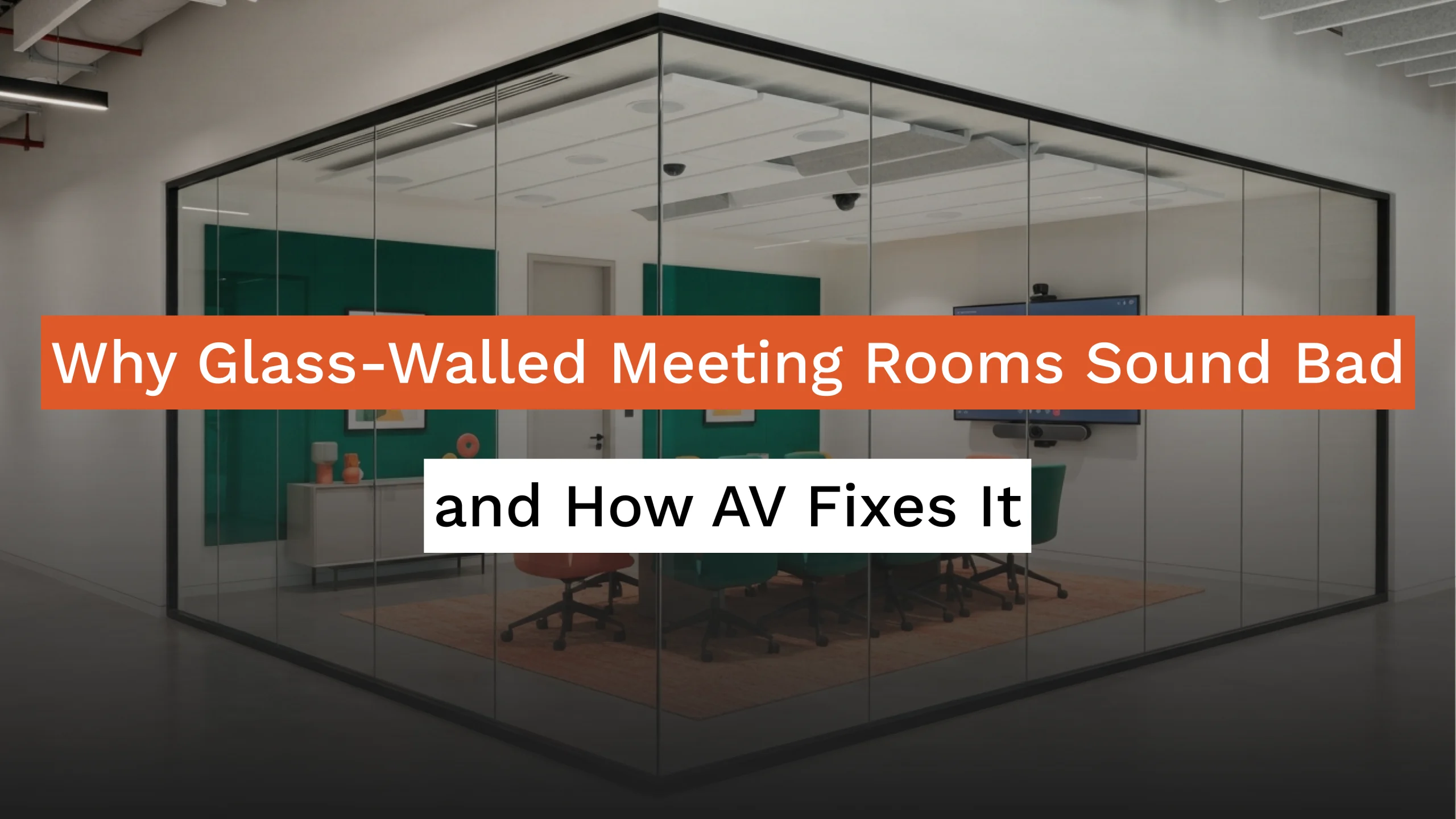
Glass-walled meeting rooms often sound worse because glass reflects sound rather than absorbing it. As voices bounce off glass surfaces, sound waves continue to reverberate around the room, reducing speech clarity and making conversations harder to follow. Unlike materials such as carpet, fabric, or acoustic panels, glass provides almost no acoustic absorption, allowing echoes and reflections to build up during meetings.
Modern office designs frequently use glass partitions to create bright, open, and collaborative workspaces. While this improves aesthetics and allows natural light to spread throughout the office, it can unintentionally create acoustic challenges. During the planning stage, businesses often prioritize furniture, displays, and video conferencing equipment while overlooking room acoustics. However, the room itself has a significant impact on communication quality. According to a survey by Oxford Integration, 55% of respondents identified poor audio and video quality as their biggest meeting room issue, highlighting how common these challenges have become.
As hybrid work becomes the norm, the impact of poor acoustics is even more noticeable. People inside the room may still understand one another, but remote participants hear everything the microphone captures, including reflected voices, background conversations, keyboard typing, and HVAC noise. These unwanted sounds reduce speech intelligibility and make online collaboration more frustrating.
Poor acoustics also affect meeting productivity. Participants often need to repeat themselves, ask colleagues to speak louder, or clarify misunderstood points. Over time, these interruptions slow decision-making, increase listener fatigue, and reduce the overall effectiveness of meetings. The issue is not the presence of glass itself, but the lack of acoustic treatment that balances the room’s reflective surfaces.
Fortunately, businesses do not need to abandon modern glass meeting rooms to achieve excellent audio quality. By incorporating acoustic treatments, selecting appropriate microphone technology, and designing a conference room audio system that accounts for the room’s acoustics, organisations can significantly improve speech clarity while maintaining the clean, contemporary appearance of glass-walled spaces.
Why do glass walls create acoustic problems?
Glass creates acoustic problems because it reflects almost all sound waves that reach its surface. Instead of being absorbed, those sound waves continue travelling around the room, creating unwanted reflections.
Every meeting room contains a mix of materials that either absorb or reflect sound. Soft materials such as upholstered chairs, carpet, curtains, and acoustic panels reduce sound energy, helping conversations remain clear. Hard materials, including glass, polished concrete, metal, and stone, do the opposite. They send sound back into the room, increasing reverberation and making speech harder to understand.
In many modern offices, glass is only one part of the problem. Meeting rooms often include exposed ceilings, hard flooring, large conference tables, and minimal soft furnishings. Together, these surfaces create an environment where sound has very few opportunities to be absorbed.
The result is a room where voices seem louder but less distinct. Participants may hear words blending together, especially when several people speak during a discussion. This effect becomes more noticeable as the room size increases because sound has more surfaces to reflect from before it fades away.
Businesses searching for ways to improve meeting room acoustics glass walls are often surprised to learn that replacing microphones alone will not solve the issue. If the room continues to reflect sound excessively, even high-quality microphones will capture those reflections.
Understanding how sound behaves inside the room is the first step toward improving communication. Once the acoustic challenges are identified, it becomes much easier to choose the right combination of room treatments and AV technology.
What causes echo and reverberation in glass meeting rooms?
Echo and reverberation occur because sound continues to reflect around the room after someone has finished speaking. In glass meeting rooms, these reflections last longer because there are very few surfaces that absorb sound.
Although people often use the two terms interchangeably, they describe different acoustic effects. An echo is a distinct repetition of sound that arrives after the original voice. Reverberation is made up of many small reflections that blend together, making speech sound less clear even if you cannot hear a noticeable echo.
Think of what happens when someone speaks in an empty room. Their voice seems louder and lingers for a moment before fading away. The same effect occurs in many glass meeting rooms, although it is often less obvious. Instead of hearing a repeated voice, participants experience conversations that sound muddy or difficult to follow.
The problem becomes worse when several reflective materials exist in the same space. Glass walls, polished floors, exposed ceilings, and large conference tables all reflect sound. When these reflections overlap, they reduce speech intelligibility and make it harder for people to distinguish individual words.
Long meetings can make this even more noticeable. As participants concentrate harder to understand conversations, listening fatigue increases. People may not realise the room acoustics are the problem, but they often leave meetings feeling more mentally tired than expected.
Why are hybrid meetings more affected by poor acoustics?
Hybrid meetings expose acoustic problems because remote participants depend entirely on the room’s microphones. If the microphones capture echo and background noise, that is exactly what remote attendees hear.
Someone sitting inside the meeting room can rely on facial expressions, gestures, and visual cues to help understand conversations. Remote participants do not have the same advantage. They rely almost entirely on clear audio to stay engaged in the discussion.
This is why a room that sounds acceptable in person can still create a poor experience online. Microphones capture direct speech along with reflections from glass walls, ventilation systems, chair movement, keyboard typing, and conversations outside the room.
Many businesses assume their video conferencing software is responsible for poor call quality. In reality, conferencing platforms can only process the audio they receive. If the original audio contains excessive reverberation or unwanted noise, software alone cannot completely restore speech clarity.
A well-designed conference room audio setup addresses this problem by combining good room acoustics with intelligent microphones, digital signal processing, and properly positioned speakers. Together, these elements produce cleaner audio before it reaches the conferencing platform.
As hybrid work becomes a permanent part of many organisations, improving room acoustics has become just as important as choosing the right meeting software.
What audio problems do businesses experience most often?
One of the most common complaints is inconsistent voice pickup. People sitting close to the microphone sound clear, while those at the opposite end of the table are difficult to hear. This creates an uneven meeting experience and forces participants to repeat themselves.
Background noise is another frequent issue. Ceiling-mounted air conditioning, office conversations, keyboard typing, and chair movement can all become part of the meeting when microphones are not designed or positioned correctly.
Speech clarity also decreases when several people contribute to the discussion at the same time. Reflected sound mixes with direct speech, making conversations feel crowded and difficult to follow. Instead of hearing distinct voices, participants hear overlapping sounds that require greater concentration.
Privacy can also become a concern. Standard glass partitions provide visual separation, but they do little to stop conversations from travelling between meeting rooms and nearby workspaces. Confidential discussions may therefore be overheard more easily than expected.
These challenges demonstrate why choosing the right meeting room audio video equipment involves more than selecting better microphones or speakers. The equipment must work with the room rather than against it.
Most organisations experience the same group of audio challenges in glass meeting rooms. While the severity varies from one space to another, the underlying causes are usually similar.
Why isn't replacing the microphone enough?
Replacing a microphone may improve audio quality slightly, but it rarely solves the underlying problem. If the room continues to reflect sound, every new microphone will capture those reflections as well.
Many organisations upgrade their conferencing hardware after receiving complaints about meeting quality. While better equipment certainly helps, it cannot change how sound behaves inside the room. A premium microphone installed in a highly reflective space will still record echo, reverberation, and background noise.
The most effective solution combines acoustic improvements with professional AV design. Once unwanted reflections are reduced, microphones can focus on capturing speech instead of the room itself. This produces clearer conversations for everyone, whether they are attending in person or joining remotely.
Understanding this relationship between acoustics and technology helps businesses make smarter investment decisions and avoid replacing equipment that is not actually causing the problem.
How do professional AV systems improve meeting room audio?
Professional AV systems improve meeting room audio by reducing unwanted noise, capturing voices more accurately, and delivering consistent sound throughout the room. Instead of simply making people louder, they make conversations easier to understand.
In many offices, meeting rooms are equipped with standard webcams or portable speakerphones because they are quick to install. While these devices work well in small spaces, they often struggle in larger rooms with glass walls and multiple participants. The result is uneven voice pickup, background noise, and poor audio for remote attendees.
A professionally designed AV system treats the room as a complete environment. Microphones, speakers, cameras, and processing equipment are selected to work together based on the room’s size, layout, and acoustic characteristics.
This approach produces clearer conversations and reduces the interruptions that occur when people repeatedly ask each other to speak louder or repeat important points.
What does a modern conference room audio setup include?
A modern conference room audio setup includes more than microphones and speakers. It combines multiple technologies that work together to deliver clear audio for both in-room and remote participants.
One of the most important components is the microphone system. Beamforming microphones have become increasingly popular because they automatically focus on the person speaking instead of capturing sound equally from every direction. This improves voice clarity without requiring participants to sit directly beside a microphone.
Digital Signal Processing, commonly called DSP, is another essential part of the system. A DSP continuously analyses incoming audio and removes unwanted echo, suppresses background noise, and balances voice levels before the sound reaches remote participants. This processing happens in real time, allowing conversations to remain natural.
Professional loudspeakers also play an important role. Rather than increasing volume, they distribute sound evenly across the room so everyone can hear comfortably. This reduces the temptation to turn the volume higher than necessary, which can introduce feedback and make conversations less comfortable.
Displays, cameras, and control systems complete the meeting room experience. Together, these technologies create an environment where communication feels natural instead of being interrupted by technical issues.
Which meeting room audio video equipment is essential today?
The right meeting room audio video equipment depends on how the room is used, but several technologies have become standard in modern collaboration spaces.
Beamforming microphones provide consistent voice pickup across the room. Unlike traditional tabletop microphones, they detect where someone is speaking and focus on that location, making discussions clearer even when participants move around.
PTZ cameras automatically pan, tilt, and zoom to follow active speakers or presenters. This creates a more engaging experience for remote attendees and reduces the need for manual camera adjustments during meetings.
Digital Signal Processors improve audio quality by removing echo, reducing background noise, and ensuring voices remain balanced throughout the conversation. They work quietly in the background, but they have a significant impact on meeting quality.
Professional loudspeakers ensure that everyone hears remote participants clearly, regardless of where they are seated. Instead of concentrating sound in one area, they provide even coverage across the room.
Wireless presentation systems have also become common in modern meeting spaces. Employees can share content directly from their laptops or mobile devices without connecting cables, making meetings easier to start and reducing clutter around the conference table.
When these technologies are integrated into a single system, meetings become more reliable and easier to manage.
Can better equipment solve every audio problem?
Better equipment improves meeting quality, but it cannot solve every problem on its own. If the room itself has poor acoustics, even high-quality hardware will have limitations.
For example, installing premium microphones in a room with excessive reverberation still means those microphones capture reflected sound. Similarly, powerful speakers cannot compensate for conversations being masked by echoes created by glass walls.
This is why AV professionals begin with an assessment of the room rather than recommending equipment immediately. Factors such as ceiling height, furniture layout, glass coverage, and participant seating all influence how sound behaves.
The most successful meeting rooms combine professional AV technology with thoughtful acoustic design. When the room supports clear communication, the equipment can perform as intended and deliver a better experience for everyone involved.
Why should businesses plan AV systems around the room instead of the products?
Every meeting room is different, so there is no single equipment package that works for every office. A small huddle room, a boardroom, and a training space all have different acoustic and technical requirements.
Planning the system around the room allows businesses to invest in equipment that matches their actual needs instead of paying for unnecessary features. It also makes future upgrades easier because the infrastructure has been designed with expansion in mind.
This approach improves long-term reliability, simplifies meeting management, and helps organisations get the most value from their AV investment.
For meeting rooms that need clearer audio, video conferencing, wireless presentation, room control, and a cleaner user experience, Oxford Integration provides customised meeting room solutions in Dubai for offices, boardrooms, huddle rooms, and conference spaces.
How can you improve meeting room acoustics in glass-walled spaces?
The most effective way to improve meeting room acoustics glass walls is to combine acoustic treatment with professional AV design. Addressing only one of these areas often leaves the original problem unresolved.
The first step is identifying the surfaces that reflect the most sound. In many modern offices, these include glass partitions, polished flooring, exposed ceilings, and large meeting tables. Together, they create an environment where sound continues to bounce around the room instead of fading naturally.
Adding sound-absorbing materials helps control these reflections. Acoustic wall panels, ceiling panels, carpet tiles, and upholstered furniture all reduce reverberation without changing how the meeting room functions. Many of these products are available in finishes that match contemporary office interiors, allowing businesses to improve acoustics while maintaining the clean appearance of glass meeting rooms.
Furniture placement also has a noticeable impact. Rooms with very little furniture tend to sound more reflective than those with bookshelves, fabric seating, or decorative acoustic elements. Even small design changes can contribute to better speech clarity.
The goal is not to eliminate every sound. Instead, it is to create a balanced acoustic environment where conversations remain clear without making the room feel unnaturally quiet.
What makes a soundproof glass conference room?
A soundproof glass conference room is designed to prevent conversations from travelling in or out of the space. This requires more than simply installing thicker glass.
Many people assume that glass walls automatically provide privacy because they separate one room from another. In reality, standard glass partitions offer limited sound isolation. Conversations can still pass through the glass itself or escape through small gaps around doors, ceilings, and window frames.
Creating an effective soundproof meeting room usually involves several architectural elements working together. Laminated acoustic glass reduces sound transmission, while sealed door systems minimise air gaps that allow conversations to leak outside. Wall construction, ceiling design, and ventilation systems must also be considered because sound often travels through these paths.
It is also important to understand the difference between soundproofing and acoustic treatment.
Soundproofing focuses on blocking noise from entering or leaving the room. Acoustic treatment improves how sound behaves inside the room by reducing reflections and reverberation.
A meeting room may have excellent sound isolation but still suffer from poor speech clarity if the internal acoustics have not been treated properly. Likewise, a room with acoustic panels may sound clear inside but still allow confidential conversations to be heard outside.
The most effective meeting spaces combine both approaches to achieve privacy and clear communication.
Can acoustic treatment replace professional AV technology?
Acoustic treatment improves the room, while AV technology improves how meetings are captured and shared. Neither solution replaces the other.
For example, installing acoustic panels will reduce reverberation and improve speech clarity, but they cannot remove background noise from a video call or automatically focus on the person speaking. Those tasks require intelligent microphones and digital audio processing.
Similarly, installing premium microphones in a highly reflective room will not eliminate echo. The microphones will continue capturing reflected sound unless the room itself is acoustically improved.
This is why successful meeting rooms are designed as complete systems. The room creates favourable acoustic conditions, while the AV technology ensures every participant hears and is heard clearly.
When both elements are planned together, the improvements become immediately noticeable. Conversations feel more natural, remote participants spend less time asking for clarification, and meetings progress with fewer interruptions.
How do acoustic treatments and AV systems work together?
Acoustic treatments and AV systems solve different parts of the same problem. Acoustic materials reduce unwanted reflections before they reach the microphones, while AV equipment processes and distributes the remaining sound as clearly as possible.
Imagine a room where voices no longer bounce endlessly between glass walls. Microphones receive cleaner audio because there is less reverberation to capture. The DSP has less corrective work to perform, allowing speech to sound more natural. Speakers can operate at comfortable volume levels because participants are already hearing conversations more clearly.
This combination produces better results than relying on either solution alone.
Businesses planning a meeting room upgrade often achieve the greatest improvement by treating acoustics and AV as a single project rather than separate investments. Doing so creates a meeting space that supports productive discussions today and remains suitable for future collaboration technologies.
Should you choose a wireless microphone with speaker for conference room meetings?
A wireless microphone with speaker for conference room meetings is a good option for smaller spaces, but it is not the best choice for every meeting room. The right solution depends on the room size, the number of participants, and how the space is used.
In small meeting rooms or huddle spaces, a wireless speakerphone can provide clear audio with minimal setup. It removes cable clutter, is easy to move between rooms, and allows teams to start meetings quickly. For businesses that regularly use flexible workspaces, this can be a practical solution.
Larger conference rooms present different challenges. Participants are often seated farther from the microphone, making it difficult for a single wireless device to capture every voice consistently. Background noise and room reflections also become more noticeable as the meeting space grows.
In these environments, ceiling microphones, distributed speakers, and digital signal processors usually deliver better results. They provide more consistent voice coverage across the room and ensure remote participants hear every speaker clearly, regardless of where they are sitting.
Choosing the right audio solution should always begin with the room itself. A device that performs well in a six-person meeting room may struggle in a boardroom designed for twenty people.
Why is professional AV design just as important as the equipment?
The quality of a meeting room depends on more than the products installed inside it. Even premium equipment can produce disappointing results if it is not designed for the room’s acoustic conditions.
Microphone placement, speaker positioning, ceiling height, furniture layout, and glass coverage all influence how sound travels through the space. Ignoring these factors can lead to uneven voice pickup, unnecessary background noise, and inconsistent meeting quality.
Professional AV design looks at the room as a complete system rather than a collection of individual products. Every component is selected to complement the room’s acoustic characteristics and support the way people use the space.
This approach reduces technical problems, improves reliability, and creates a meeting experience that feels natural instead of distracting.
How does Oxford Integration help improve meeting room performance?
Oxford Integration designs meeting rooms that balance modern office aesthetics with reliable communication technology. Rather than recommending the same equipment for every project, the process begins with understanding how the room will actually be used.
Room size, seating layout, collaboration requirements, and existing infrastructure are all considered before selecting meeting room audio video equipment. This helps ensure that microphones, speakers, displays, cameras, and control systems work together instead of operating as separate technologies.
The result is a meeting space where conversations are easier to follow, hybrid meetings run more smoothly, and employees spend less time dealing with technical issues.
Whether the project involves upgrading an existing room or designing a new collaboration space, careful planning helps create a solution that supports both current and future workplace needs.
What should you consider before upgrading a meeting room?
The first step is understanding what is causing the problem. If meetings regularly suffer from echo, poor speech clarity, or inconsistent audio, replacing a single device is unlikely to solve the issue.
An assessment of the room can identify where sound reflections occur, how microphones perform in different seating positions, and whether the current conference room audio setup provides adequate coverage. This information makes it easier to choose improvements that deliver measurable results.
Businesses should also think about how the room may be used in the future. As hybrid working continues to evolve, meeting rooms need to support in-person collaboration, remote participation, and changing technology without requiring major redesigns every few years.
Planning for future requirements often provides better long-term value than focusing only on today’s immediate needs.
Conclusion
Glass-walled meeting rooms create bright, modern workspaces, but they also introduce acoustic challenges that can make conversations harder to understand. Reflections from glass surfaces, background noise, and inconsistent microphone coverage all reduce the quality of in-person and hybrid meetings.
Improving these spaces requires more than installing better hardware. A combination of acoustic treatment, intelligent microphones, digital signal processing, and carefully selected meeting room audio video equipment creates an environment where speech remains clear throughout the room.
Businesses looking to improve meeting room acoustics glass walls should evaluate both the room and the technology before making upgrades. Where privacy is equally important, investing in a properly designed soundproof glass conference room can improve confidentiality while supporting better communication.
The most effective meeting rooms are planned as complete environments, where acoustics and AV technology work together to help every participant hear and be heard clearly.
Frequently Asked Questions
Why do glass-walled meeting rooms create echo?
Glass reflects sound instead of absorbing it. As sound bounces between hard surfaces, it creates reverberation and echo that reduce speech clarity.
How can I improve meeting room acoustics with glass walls?
You can improve meeting room acoustics glass walls by adding acoustic panels, ceiling treatments, soft furnishings, and a professionally designed AV system that includes intelligent microphones and digital signal processing.
What equipment is included in modern meeting room audio video equipment?
Most systems include microphones, speakers, DSP processors, PTZ cameras, displays, wireless presentation systems, and touch control panels that work together to support meetings.
Is a wireless microphone with speaker for conference room use suitable for large rooms?
Wireless speakerphones work well in smaller meeting spaces. Larger conference rooms usually require dedicated microphones, distributed speakers, and professional AV design for consistent audio coverage.
What is the difference between acoustic treatment and soundproofing?
Acoustic treatment improves sound quality inside the room by reducing reflections. Soundproofing prevents noise from entering or leaving the room. Both play different roles in creating an effective meeting environment.