
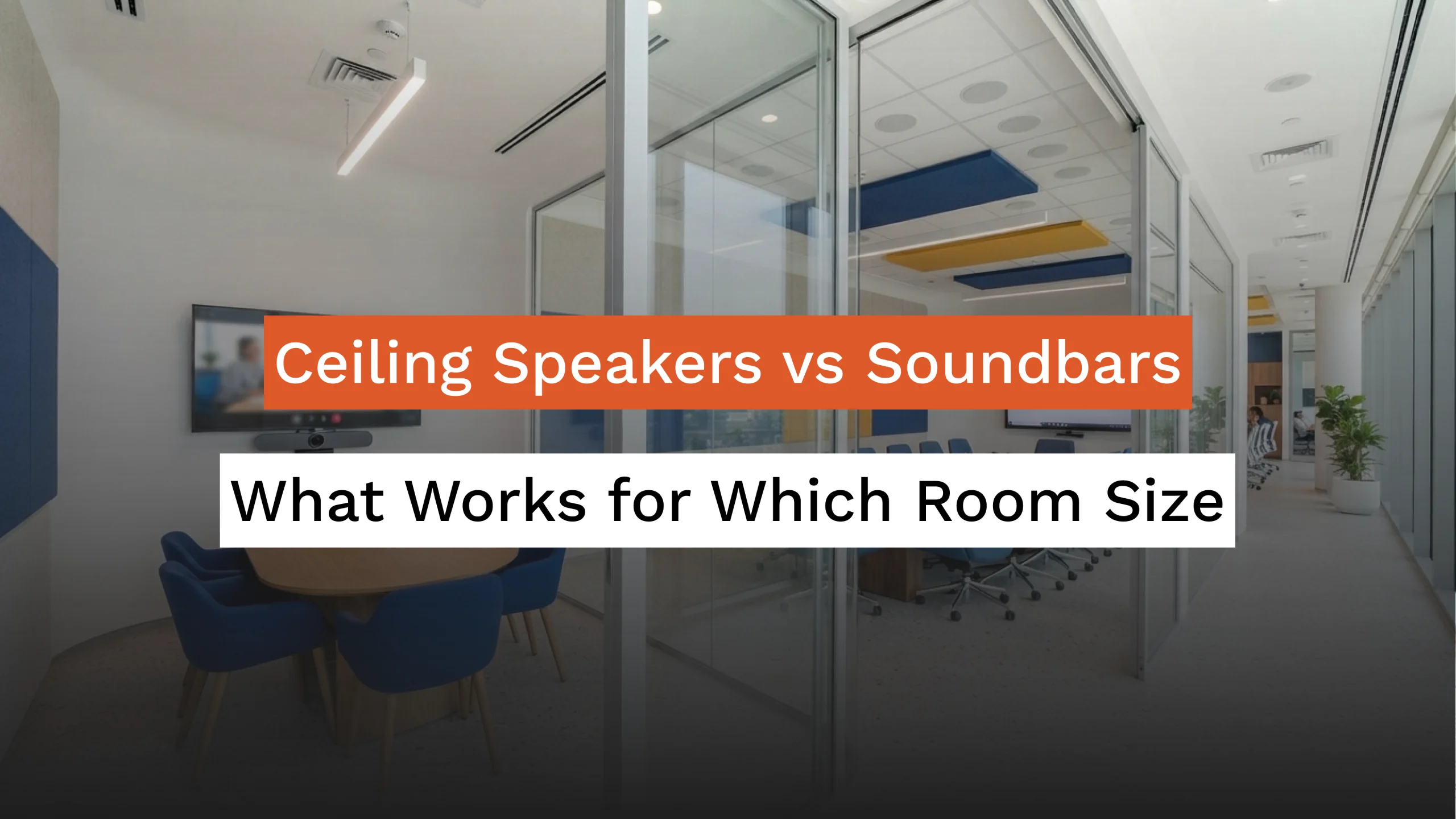
TL;DR
- Ceiling speakers provide even audio coverage and are usually the better choice for medium and large meeting rooms.
- Soundbars work well in small meeting rooms where everyone sits close to the display.
- Your room size, seating layout, and conferencing needs should determine whether you choose sound bar vs ceiling speakers.
- A well-designed meeting room speaker system improves speech clarity for both in-room and remote participants.
- Planning for future growth can save money by reducing the need for major upgrades later.
If participants struggle to hear presentations or remote attendees miss parts of the conversation, meetings become longer and less effective. Choosing between sound bar vs ceiling speakers is one of the most important decisions when designing a modern conference room.
This guide explains where each solution performs best, what factors affect audio quality, and how to select the right meeting room speaker system for your business.
Why does a meeting room microphone cut out during calls?
If your meeting room microphone cuts out during an important meeting, the microphone itself isn’t always the problem. Most interruptions happen because another part of the conference room AV system stops communicating correctly.
A modern meeting room includes much more than a microphone. Audio passes through USB interfaces, digital signal processors (DSPs), conferencing software, network switches, speakers, and operating systems before remote participants hear your voice. A fault anywhere in that chain can interrupt audio for a few seconds or disconnect it entirely.
These interruptions often appear randomly. One meeting works perfectly, while the next experiences missing words, frozen audio, or complete microphone failure. Understanding where these issues originate is the first step toward fixing them permanently.
Why does room size matter when choosing meeting room speakers?
Room size is the biggest factor because audio behaves differently in small and large spaces.
A speaker that sounds excellent in a compact huddle room may struggle to provide consistent coverage in a larger conference room. As the distance between the speaker and listeners increases, speech becomes less even, and some participants may hear conversations more clearly than others.
Other factors also affect performance, including:
- Number of participants
- Seating arrangement
- Ceiling height
- Room acoustics
- Type of video conferencing platform
- Microphone placement
When selecting speakers for meeting room environments, businesses should evaluate the entire space instead of choosing equipment based only on price or appearance.
Research from the National Institute of Standards and Technology highlights that speech intelligibility is one of the key factors influencing communication quality in conferencing environments. Poor room acoustics can reduce comprehension even when participants are using high-quality displays.
What are ceiling speakers, and when should you use them?
Ceiling speakers are designed to spread sound evenly across an entire room instead of projecting audio from a single location.Rather than placing one speaker near the display, several speakers are installed throughout the ceiling.
This allows everyone in the room to hear presentations and conversations at a similar volume, regardless of where they are seated.
This makes ceiling speakers a strong option for businesses that need consistent performance from their meeting room speaker system.
Ceiling speakers are commonly installed in:
- Medium conference rooms
- Executive boardrooms
- Training rooms
- Large collaboration spaces
- Multi-purpose meeting facilities
Another advantage is appearance. Because the speakers are recessed into the ceiling, they blend into the room without adding visible hardware or cables. Many businesses prefer this clean look when designing modern offices.
Ceiling speaker systems can also grow with the business. If a room is expanded or reconfigured later, additional speakers can often be added without replacing the entire audio system.
What is a soundbar, and when is it the better option?
A soundbar combines several speaker drivers inside one compact unit that is mounted above or below the room display.
Many business soundbars also include microphones, echo cancellation, and digital signal processing. This allows them to function as an all-in-one conferencing device without requiring multiple separate components.
For smaller meeting spaces, sound bar vs ceiling speakers often becomes an easy decision because a quality soundbar can provide excellent voice clarity while keeping installation simple.
Businesses frequently install soundbars in:
- Huddle rooms
- Small meeting rooms
- Interview rooms
- Private offices
- Focus rooms
Most business models connect directly to conferencing platforms such as Microsoft Teams, Zoom, and Google Meet through USB or network connections, making deployment straightforward.
Because the sound comes from one location, soundbars perform best when participants remain relatively close to the display. As room size increases, maintaining consistent audio coverage becomes more difficult.
When choosing speakers for meeting room installations, understanding this limitation helps avoid uneven listening experiences as meeting spaces grow.
How do both options compare before looking at room size?
Both solutions deliver high-quality audio, but they solve different problems.
A soundbar focuses on simplicity. It combines speakers, microphones, and audio processing into one device that is quick to install and easy to manage.
Ceiling speakers focus on coverage. They distribute sound throughout the room and usually form part of a larger audio system for conference spaces that includes dedicated microphones, amplifiers, and control systems.
The decision between sound bar vs ceiling speakers should therefore be based on room requirements rather than which product appears more advanced.
Which option works best for small meeting rooms?
For small meeting rooms with two to six participants, a soundbar is usually the better choice.
Everyone sits close to the display, so audio reaches each participant at a similar volume. A business soundbar can also combine speakers, microphones, and echo cancellation into one device, reducing installation time and equipment costs.
This is one reason why sound bar vs ceiling speakers often favour soundbars in compact collaboration spaces. They provide clear speech without the need for ceiling modifications or additional amplifiers.
A small room typically benefits from:
- One business soundbar
- Integrated microphones
- USB or network connectivity
- Simple installation
- Minimal maintenance
If your meetings mainly involve video calls, presentations, and team discussions, a quality soundbar can easily meet the room’s audio requirements.
Which option works best for medium-sized meeting rooms?
Medium-sized meeting rooms usually benefit more from ceiling speakers.
Once a room seats six to twelve people around a long table, audio consistency becomes much more important. Participants sitting near the display often hear louder sound than those seated farther away when using only a soundbar.
This is where ceiling speakers make a noticeable difference. Multiple speakers distribute audio evenly across the room, creating a more balanced listening experience for everyone.
When comparing sound bar vs ceiling speakers, this is the point where ceiling speakers begin to outperform soundbars in everyday business use.
A properly designed meeting room speaker system for medium-sized rooms offers:
- Even sound distribution
- Better speech intelligibility
- Reduced volume differences across seating positions
- Greater flexibility for future room upgrades
Many businesses also pair ceiling speakers with dedicated microphones to improve voice pickup during hybrid meetings.
Which option works best for large conference rooms?
Large conference rooms almost always require ceiling speakers. Rooms designed for executive meetings, client presentations, training sessions, or board discussions need consistent audio throughout the entire space. A single soundbar cannot provide the same level of coverage across long tables or wide seating layouts.
Instead, several ceiling speakers work together as part of a complete audio system for conference environments. This approach helps every participant hear presentations clearly, regardless of where they are seated.
For large meeting spaces, ceiling speakers offer:
- Uniform audio coverage
- Better support for larger audiences
- Higher speech clarity
- Easier integration with professional conferencing systems
- Better scalability as room requirements change
Businesses planning new conference facilities often choose ceiling speakers because they support long-term expansion without redesigning the entire meeting room speaker system.
How does sound coverage differ between both solutions?
Ceiling speakers provide more consistent sound coverage, while soundbars project audio from one direction.
A soundbar sits near the display and sends audio toward meeting participants. Although modern models use advanced speaker technology, listeners farther away may still experience lower volume and reduced speech clarity.
Ceiling speakers solve this problem by spreading audio throughout the room. Because multiple speakers share the workload, each speaker operates at a lower volume while maintaining consistent sound levels.
This makes speakers for meeting room installations using ceiling speakers particularly effective in spaces where participants sit across several rows or around large conference tables.
Better sound coverage also reduces the need to increase overall volume, making conversations more comfortable during long meetings.
Which solution is easier to install?
Soundbars are easier and faster to install. Most business soundbars require mounting near the display and connecting power, USB, HDMI, or network cables. Installation can often be completed within a few hours without significant changes to the room.
Ceiling speakers require more planning. Installers must determine speaker placement, cable routes, amplifier requirements, and acoustic coverage before installation begins.
Although the process takes longer, the result is a professionally designed audio system for conference rooms that delivers better long-term performance.
Businesses should consider the following before installation:
- Current room size
- Ceiling construction
- Existing AV infrastructure
- Future expansion plans
- Number of participants
- Type of conferencing platform
Choosing the right speakers for meeting room environments is easier when installation is planned around how the room will be used over the next several years, not just its current requirements.
Which solution delivers better microphone performance?
The best microphone setup depends on room size and how often the room is used for video conferencing. Many business soundbars include built-in beamforming microphones. These microphones focus on the person speaking while reducing background noise, making them a practical option for smaller meeting rooms.
In medium and large conference rooms, dedicated ceiling or tabletop microphones usually deliver better results. Participants may be seated several metres apart, and a single microphone built into a soundbar may not capture every voice with the same clarity.
A professionally designed meeting room speaker system often combines ceiling speakers with separate microphone arrays. This setup improves voice pickup and creates a more natural conversation for remote participants.
If hybrid meetings are a regular part of your business, microphone placement should receive as much attention as speaker selection.
Which option provides a better experience for video conferencing?
Both solutions support modern conferencing platforms, but they perform differently as room size increases.
A soundbar works well in small rooms where participants sit close together. Integrated microphones, speakers, and digital signal processing make setup straightforward for platforms like Microsoft Teams, Zoom, and Google Meet.
As rooms become larger, distributed ceiling speakers paired with dedicated microphones provide a better audio system for conference environments. Everyone hears remote participants clearly, and people joining the meeting online can understand voices from anywhere in the room.
When evaluating sound bar vs ceiling speakers, businesses should consider the quality of communication in both directions, not just how loud the speakers are.
Which option looks better in a modern office?
Ceiling speakers offer the cleanest appearance because they remain almost invisible after installation.
Modern offices often aim for uncluttered meeting spaces with minimal equipment on display. Recessed ceiling speakers help maintain that design while providing full-room audio coverage.
Soundbars also have a professional appearance. Their slim profile fits neatly beneath displays and requires very little additional hardware.
The right choice depends on the room itself:
- Small collaboration rooms often suit soundbars.
- Executive boardrooms usually benefit from concealed ceiling speakers.
- Training rooms often prioritise even sound coverage over visible equipment.
When selecting speakers for meeting room installations, appearance should support functionality rather than become the primary deciding factor.
Which solution requires less maintenance?
Both options require relatively little maintenance, but ceiling speakers usually need less attention after installation.
Soundbars remain accessible, making firmware updates and occasional cleaning straightforward. Because they are mounted at eye level, they are also more likely to be touched or moved during room changes.
Ceiling speakers are protected above the workspace and are less exposed to accidental damage. Once installed correctly, they often operate for years with only routine system inspections.
Businesses investing in a permanent meeting room speaker system frequently appreciate this long-term reliability, especially in conference rooms that are used throughout the day.
Which option offers better long-term value?
The answer depends on how often the meeting room is used and whether the business expects future growth.
A soundbar usually has a lower upfront cost. Installation is simple, additional hardware is limited, and the room can be operational quickly.
Ceiling speakers require a higher initial investment because they involve professional installation, wiring, and supporting equipment. However, they can be expanded as business requirements change and often remain part of the room for many years.
Instead of comparing purchase prices alone, businesses should consider:
- Expected room usage
- Number of meetings each week
- Future office expansion
- Upgrade flexibility
- Equipment lifespan
For organisations that rely heavily on collaboration, a professionally designed audio system for conference rooms can provide better value over time by reducing the need for major upgrades.
How do you choose the right audio solution?
Start by assessing how the room is used, rather than choosing equipment based on specifications alone.
Consider how many people typically attend meetings, whether video conferencing is part of the workflow, and whether the room may be expanded in the future.
Questions worth asking include:
- How many people use the room regularly?
- How large is the meeting table?
- Will remote participants join most meetings?
- Is consistent audio coverage more important than simple installation?
- Will the room need to support future upgrades?
These answers make it easier to decide between sound bar vs ceiling speakers and ensure the chosen solution supports everyday business needs.
For organisations planning new meeting spaces or upgrading existing conference rooms, Oxford Integration helps evaluate room dimensions, seating layouts, conferencing platforms, and acoustic requirements before recommending the most suitable solution. This approach ensures businesses install speakers for meeting room environments that match how the space is actually used, rather than relying on a one-size-fits-all approach.
Which option should your business choose?
The right choice comes down to room size and how your teams collaborate.
If your meeting room is used by a small group sitting close to the display, a business soundbar offers excellent performance with minimal installation. It is a practical option for huddle rooms, interview rooms, and small collaboration spaces.
If your conference room regularly hosts larger meetings, training sessions, or client presentations, ceiling speakers are the better investment. Their ability to deliver even sound throughout the room creates a more comfortable experience for both in-room and remote participants.
When comparing sound bar vs ceiling speakers, there is no single winner for every business. The best solution is the one that matches your room layout, conferencing requirements, and future expansion plans.
Conclusion
Choosing the right audio solution is about more than installing speakers. It is about creating a meeting environment where every participant can communicate clearly without distractions or uneven sound coverage.
For smaller spaces, soundbars provide a simple and cost-effective solution. For medium and large conference rooms, ceiling speakers offer better audio distribution, improved speech clarity, and greater flexibility for future upgrades. A professionally designed meeting room speaker system also helps businesses get the most from their video conferencing platforms and daily collaboration tools.
If you’re planning a new meeting space or upgrading an existing one, Oxford Integration can help you select the right audio system for conference rooms based on room size, seating layout, and collaboration needs. A well-planned installation ensures your speakers for meeting room environments continue to deliver reliable performance as your business grows.
Frequently Asked Questions
Which is better, sound bar vs ceiling speakers for a meeting room?
It depends on the room size. Soundbars are ideal for small meeting rooms where participants sit close to the display. Ceiling speakers provide more even sound coverage and better speech clarity in medium and large conference rooms.
How do I choose the right speakers for meeting room installations?
Consider the room dimensions, seating capacity, conferencing platform, and how often the space is used. Small rooms often work well with soundbars, while larger rooms benefit from distributed ceiling speaker systems.
Why is a professional audio system for conference rooms important?
A professional audio system improves speech intelligibility, reduces echoes, and helps remote participants hear every conversation clearly. Better audio leads to more productive meetings and fewer communication issues.
What makes a good meeting room speaker system?
A good system delivers consistent sound throughout the room, integrates with conferencing platforms, supports high-quality microphones, and can be expanded as business requirements change.
Are ceiling speakers worth the investment?
Yes. Businesses that use conference rooms regularly often benefit from ceiling speakers because they provide uniform audio coverage, require minimal maintenance, and support future upgrades without replacing the entire system.