TL;DR
- Laser light sources last far longer than lamps, so big venues skip most lamp swaps and the ladders or lifts that come with them.
- Brightness fades slowly and evenly, which keeps large screens readable for years.
- Instant start and stop suits venues that run back-to-back sessions.
- A short throw laser projector helps where people walk in front of the beam or the ceiling is hard to reach.
- Laser projector price is higher upfront, so compare the cost over five years, not the sticker.
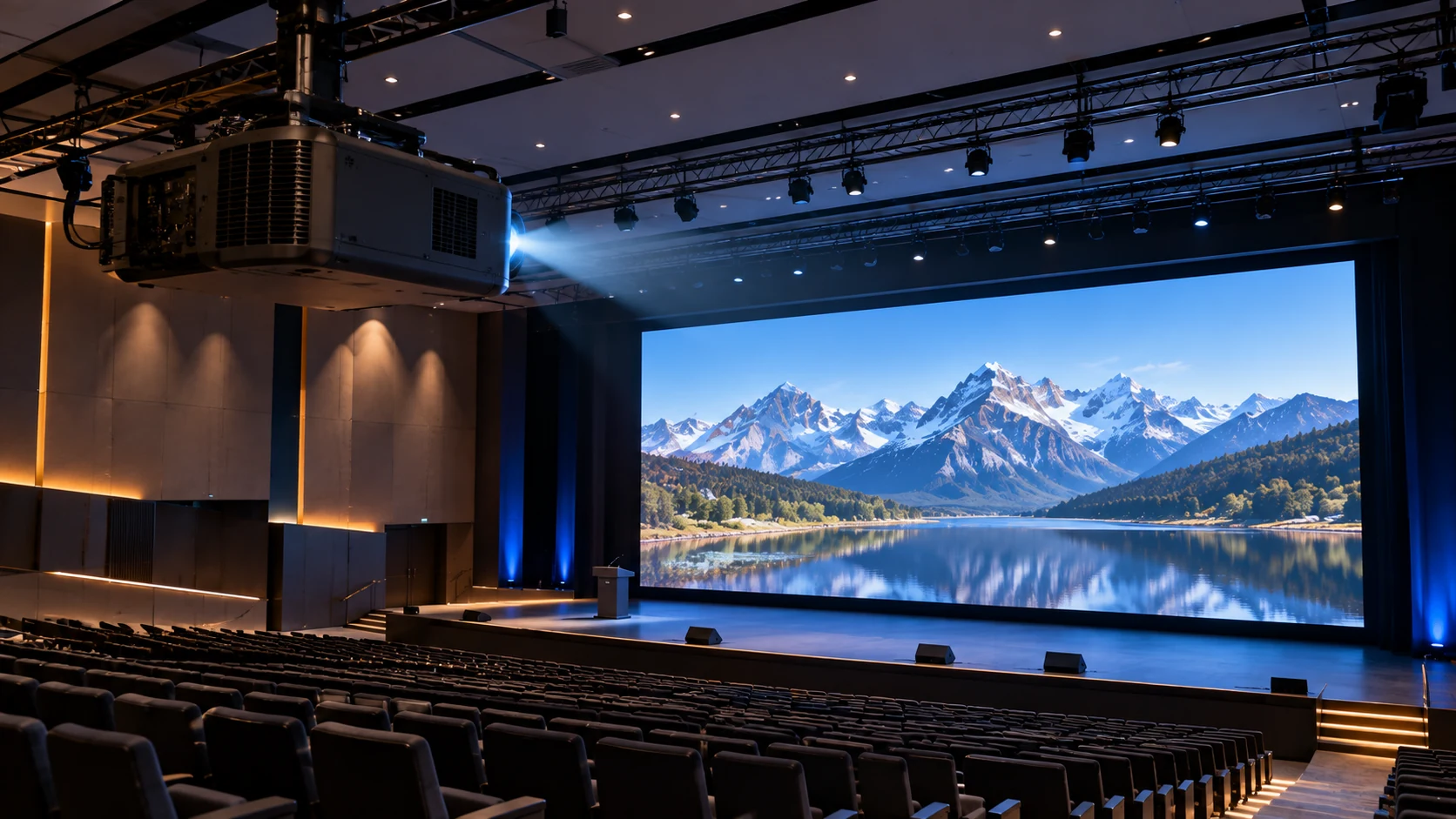
Large commercial venues need projectors that stay bright for thousands of hours and rarely need service. A laser projector meets that need better than a lamp model in most cases, mainly because of longer light source life, steadier brightness and lower upkeep. This guide explains why, where lamps still make sense, and what to check before you buy.
If you run a conference centre, cinema, worship hall or shopping mall, you already know upkeep drives the real cost of a projector. The ladder hire, the downtime and the dim image ten minutes before a keynote all add up.
What counts as a large commercial venue?
A large commercial venue is any space where a projector runs many hours a day, hangs far from the floor, or fills a big screen for a big audience. That covers more than most people expect.
Common examples include:
- Conference halls and hotel ballrooms
- Cinemas and live event theatres
- Houses of worship
- Airports, malls and retail atriums
- Museums and visitor attractions
- Lecture theatres and training campuses
- Exhibition centres and showrooms
These spaces share three problems. The projector is hard to reach, the schedule is tight, and a failed image is visible to hundreds of people. Every feature below is judged against those three problems.
Why does light source life matter so much in big venues?
Light source life matters because every lamp change in a large venue costs more than the lamp itself. Someone has to book a lift, close the room and test the picture afterwards.
Lamp projectors typically need a new lamp every 1,500 to 6,000 hours, depending on the model and the brightness mode. Laser light sources are commonly rated at 20,000 hours. Epson, for example, states its 20,000 hour figure as the time until brightness falls to half its starting level under test conditions, so treat it as a rating, not a promise.
Here is what that looks like in practice. This is an illustrative example, not a client case.
Say a 600-seat hall runs its projector 10 hours a day. A lamp rated for 2,500 hours would be due for replacement in roughly 250 days, so nearly once a year. A laser source rated for 20,000 hours would last about five and a half years at the same pace. Over that period you would book a lift and a technician several times for the lamp model and close to zero times for the laser one.
How much does a lamp change really cost?
The lamp is the smaller part of the bill. Installers point out that labour is a real cost, especially when the projector sits in a high ceiling. Another supplier notes that tricky installs can mean scaffolds or scissor lifts, plus the downtime while they are on site.
One UK installer works out that a lamp projector would need around seven bulbs at £150 or more each to match 20,000 hours, before fitting and other maintenance. That is about £1,050 in bulbs alone, using their figures.
What happens to brightness as the projector ages?
A lamp fades noticeably as it ages, while a laser source dims slowly and predictably. One distributor explains that lamps lose most of their brightness in the first half of their life, while laser output declines in a steady line across its rated hours.
For a big venue, this matters more than the headline lifespan. A 20-metre-wide screen that looked sharp in year one and washed out by year two sends complaints to the AV team. A slow, even decline gives you time to plan a replacement instead of reacting to one.
Another installer notes that a lamp is usually swapped once its output drops below half of the original, which in a busy venue can arrive sooner than the printed lamp hours suggest.
Does a laser projector really need less maintenance?
Yes, because there is no lamp to replace and the light source is not the part that wears out first. A laser projector still needs basic care, though, and it is fair to say so.
Epson’s own footnote says the 20,000 hour rating depends on the air quality in the room and that parts other than the light source may need replacing sooner. In a dusty venue, such as a workshop-style exhibition hall or a space with a lot of fog effects, plan to clean or replace filters on schedule.
Here is the practical difference for a facilities team:
- Lamp models: track lamp hours, keep spares, book access, replace, reset the counter, recheck the picture.
- Laser models: clean filters, check the mount, update firmware, and run the unit.
There are also fewer surprises. Replacement lamps can fail early or arrive late, and both problems disappear when there is no lamp.
How does instant on and off help a busy venue?
Instant on and off means the projector is usable within seconds, which removes waiting time between sessions. Lamp projectors need a few minutes to warm up and can take up to thirty minutes to reach stable brightness. Many also need to stay plugged in after shutdown so the fan can cool the lamp.
Laser models are ready almost immediately and do not have that cooling dependency.
Take a hotel ballroom that hosts a morning seminar, a lunch presentation and an evening wedding on the same day. Staff can switch the projector off between events to save power and heat, then bring it back in seconds. With a lamp unit, staff usually leave it running, which burns lamp hours and adds heat to the room.
There is a second benefit for venues that run all day. One Australian supplier states that laser models can operate up to 24 hours a day. That suits airport displays, retail loops and visitor attraction screens that never really switch off.
Are laser models bright enough for large screens and lit rooms?
Yes, but brightness has to be matched to the screen size and the room, so check the ANSI lumen rating and not the marketing number. A laser projector with a higher ANSI lumen rating is brighter, and that rule holds for lamp models too, as one Australian retailer’s FAQ explains.
Two things work against you in a large venue. A bigger screen spreads the same light over more area, so the image looks dimmer. Ambient light from windows, exit signs and stage lighting washes the image out further.
Laser sources help because they hold their brightness across their life, so the figure you buy is close to the figure you keep. They also tend to give a wider colour range and stronger contrast, according to one home cinema specialist.
For very wide images, venues often combine several projectors with edge blending, which merges overlapping images into one continuous picture. Matching brightness and colour across units is much easier when none of them is fading at a different rate. Projection mapping, which fits video onto irregular surfaces such as building facades or stage sets, benefits in the same way.
Where does a short throw laser projector fit in a large venue?
A short throw laser projector fits anywhere the projector must sit close to the screen, such as lobbies, interactive exhibits, side screens and training rooms inside large buildings. It solves shadow and placement problems that long throw units cannot.
Throw ratio is the distance from the lens to the screen compared with the image width. Definitions vary by brand. One reference treats a ratio of 0.4 or less as short throw. A UK retailer puts short throw at 0.6 to 0.8 and ultra short throw at around 0.4. Always check the exact ratio in the spec sheet.
A buying guide gives a clear example. A standard 1.5:1 projector needs to sit 7.5 feet back to fill a 5-foot-wide image, while an ultra short throw model at 0.37:1 needs about 1.4 feet. That difference decides whether the projector lives on the ceiling or a low bracket near the wall.
Where does that help in a commercial setting?
- Retail and showrooms: shoppers can walk in front of the screen without casting a shadow, because the beam comes from above at a steep angle. Short throw models are less likely to cast shadows when someone crosses the image.
- Museums and visitor attractions: interactive walls and floor displays work without a long projection path.
- Large corporate campuses: meeting and training rooms often have low ceilings or glass walls where a rear mount is impossible.
- Places of worship: a side wall or narrow front screen can be filled without a projector in the sightline.
One caution: short throw units send light at a steep angle, so screen flatness matters. One retailer recommends a fixed frame screen and advises against roll-up screens for ultra short throw setups.
How do laser and lamp projectors compare side by side?
Laser wins on lifespan, brightness stability, start-up and maintenance, while lamp models win on upfront price. The table below summarises typical figures from the sources linked in this article. Actual numbers depend on the model and mode.
Feature | Laser | Lamp |
Typical light source life | About 20,000 hours | 1,500 to 6,000 hours |
Brightness over time | Steady, gradual decline | Drops faster early on |
Warm-up | Almost instant | Minutes, up to 30 for stable brightness |
Maintenance | Filter care, no lamp swaps | Regular lamp replacement |
Ceiling access needed | Rarely for light source | Every lamp change |
Continuous use | Suited to long hours | Depends on lamp mode |
Mercury content | Mercury free | Typically contains mercury lamps |
Upfront cost | Higher | Lower |
The last row is the one that slows down decisions, so it gets its own section.
How does laser projector price affect the decision?
Laser projector price is higher at purchase, but the gap narrows once you count lamps, labour and downtime. Buying on the sticker price alone favours lamp models. Buying on five-year cost usually favours laser in a busy venue.
I cannot give you honest price figures without your product range, so this article leaves that to you.
Ask every supplier for the full laser projector price, including the lens, mount, cabling, installation and warranty. A low headline number that excludes the lens can mislead you, especially on models with interchangeable optics.
What should you include in a cost comparison?
Add up these items for each option over the same period, ideally five years:
- Purchase price and installation
- Replacement lamps or filters
- Labour and access equipment for each change
- Downtime, including lost bookings or delayed events
- Power use
- Warranty length and what it covers
Use the earlier hall example. At 10 hours a day, the laser unit needs no light source change in five years. The lamp unit needs about five, and each one involves a lift, a technician and a room closure. Put your own numbers in and the result may surprise you.
What drives the cost up?
Resolution, brightness class, lens options and warranty length all raise the price. A 4K resolution model with a high ANSI lumen rating and a motorised zoom lens will cost far more than a basic XGA unit for a small meeting room.
Do not pay for brightness you do not need, and do not save money by buying too little. Underpowered projectors in a large venue are the most common regret.
When do lamp projectors still make sense?
Lamp models still make sense for short-term hire, very small budgets, or venues that use a projector only a few hours a year. If a unit is used for a handful of events, it may never reach its first lamp change, and the lower price wins.
They also suit temporary installs where you plan to replace the whole system soon. Be honest about your usage pattern. A venue that runs a projector 20 hours a week has a different answer from one that runs it 20 hours a day.
What should you check before you buy?
Check brightness, throw ratio, resolution, warranty, filters and service access before you sign anything. Use this list when you speak to suppliers:
- ANSI lumens: ask for the rated figure, not a peak value, and match it to your screen size and room lighting.
- Throw ratio and lens options: confirm the unit can fill your screen from the mounting position you actually have.
- Resolution: choose based on what you will display. Spreadsheets and CAD drawings need more detail than slides.
- Warranty terms: some suppliers offer up to, but read what is covered, including the light source.
- Dust and filters: find out how often filters need cleaning in your type of space.
- Noise: ask for the fan noise rating, because a quiet chapel hears things a busy mall does not.
- Connections: confirm HDMI, HDBaseT or network control fits your existing cabling.
- Safety documentation: ask for the manufacturer’s laser safety classification and installation guidance.
If you plan to use a short throw laser projector, add two more checks: the exact throw ratio in the spec sheet, and whether your screen surface can handle a steep projection angle.
Our venue projector buying guide walks through screen sizing and lumen matching in more detail. If you want a second opinion on placement, our projector installation service page explains how site surveys work.
Final Thoughts
Laser projection suits large commercial venues because it removes the parts of projector ownership that cost the most: lamp changes, high-access labour, fading images and warm-up delays. A laser projector costs more on day one, and lamp models still make sense for light or temporary use. For a venue running many hours a day, laser usually gives lower total cost and fewer disruptions.
Your next step is simple. Measure your screen width, the mounting distance and the room’s lighting, then request a five-year cost sheet from two suppliers, with the lens and installation included. If you want us to review those numbers, send us your venue details through our quote form and we will check the brightness and throw ratio for you. You can also compare options on our venue AV solutions page.
Frequently Asked Questions
Is a laser model worth it for a venue that only runs a few hours a week?
How long does a laser projector last?
Most manufacturers rate the light source at around 20,000 hours. That equals roughly , according to one installer. Real life depends on heat, dust and brightness settings, so check the manufacturer’s terms.
What is a short throw laser projector?
A short throw laser projector produces a large image from a short distance, using a lens with a low throw ratio. It sits close to the screen or wall, which reduces shadows and simplifies mounting. Ultra short throw versions sit even closer.