
TL;DR
- A 4K projector is worth it when the image is large, viewers sit close, or people read fine detail such as CAD drawings, dense spreadsheets, or medical images.
- For a standard meeting room with slides and video calls, WUXGA or 1080p is usually enough. Put the savings into brightness or a better screen.
- Pixel-shifted 4K suits most installs. Native 4K matters when detail is the main job of the room.
- A laser light source rated at 20,000 hours changes the cost math more than resolution does.
- Check your source, cabling, and content first. Extra pixels do nothing if the signal is 1080p.
This post explains when a 4K projector is worth the money in a commercial AV installation, and when a cheaper WUXGA or 1080p unit does the same job. It covers viewing distance, pixel shifting versus native 4K, laser light sources, and the real cost of ownership. If you are specifying a boardroom, auditorium, control room, or lobby, you should be able to make the call by the time you finish reading.
What does a 4K resolution projector actually add to a room?
A 4K resolution projector adds pixels first. Brightness, contrast, and color come from other parts of the projector. A true 4K image is 3840 x 2160, which works out to about 8.3 million pixels. That is roughly four times the pixel count of standard 1080p.
More pixels mean finer detail, but only if the viewer can see it. Sit far from a modest image and most people cannot resolve the extra detail. Sit close to a large image and they can.
Small text and thin lines show the difference first. Spreadsheets, floor plans, engineering drawings, and code all look cleaner at 4K. A photo of a lobby or a slide with three words on it looks almost the same at either resolution.
How do you know if your room needs 4K?
Measure the farthest viewer and the smallest detail they must read, then check both against a standard instead of guessing. The industry standard for this is DISCAS, published by AVIXA as ANSI/INFOCOMM V202.01:2016. It sets image size based on where people sit and what they need to see.
What are the two DISCAS methods?
DISCAS has a basic method and an analytical one. The basic method suits general viewing. The analytical method suits content where people must pick out detail, and its free calculator takes four inputs: image height, vertical image resolution, farthest viewer, and viewing ratio. You can solve for any one of them.
That last part is useful. You can enter the farthest viewer and the screen height, and the calculator tells you the maximum resolution that viewer can use. If 1080 rows already covers it, 4K adds nothing for that seat.
What does the math look like in a real room?
Take a 16:9 image with a 120-inch diagonal. It is about 59 inches tall. At 1080 rows, each pixel row is about 0.054 inches. At 2160 rows, it is about 0.027 inches. If the person in the back row cannot tell those two pixel sizes apart, 4K gives them nothing.
Which commercial spaces get the most from 4K?
Spaces where people read detail up close or view very large images get the most from 4K. Spaces where people watch slides from a comfortable distance get the least. Here is how the common venues sort out.
Do boardrooms and meeting rooms need 4K?
Most do not. A typical meeting room shows presentations, shared documents, and video calls. The content is often 1080p or lower, and the room is small enough that viewers cannot resolve more detail. A bright WUXGA projector with good lens shift and a matched screen is usually the better spend.
The exception is a room where people review dense data. Finance teams working in wide spreadsheets and analysts reading detailed dashboards benefit from the extra sharpness.
Do auditoriums and lecture halls need 4K?
Large halls benefit when the image is very big, but brightness and lens choice matter first. The back row of a big hall is far away, so most of the resolution advantage disappears there. The front rows are a different story if the image is large.
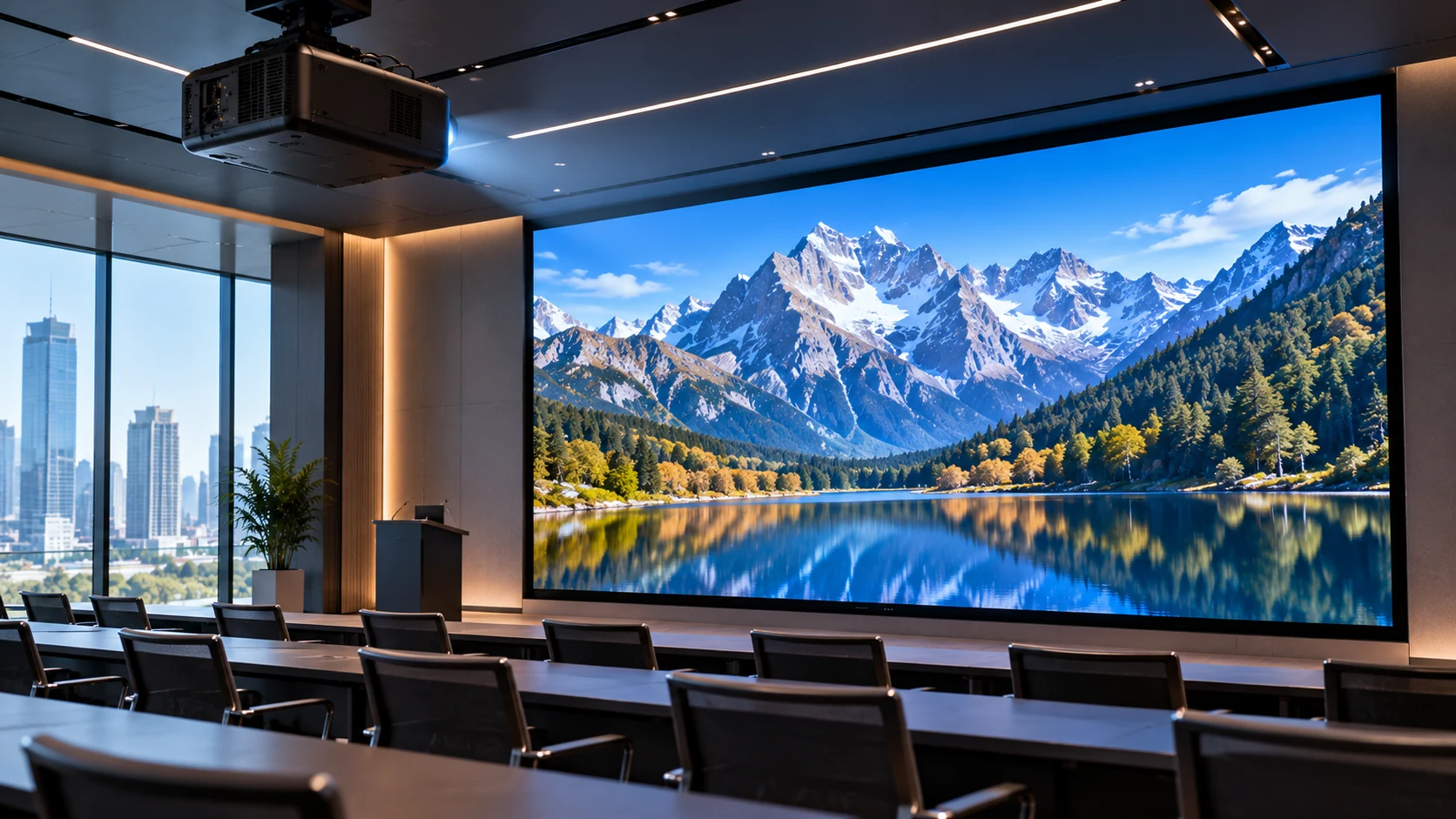
A laser projector 4K unit suits halls that show video, photography, or detailed diagrams on a big screen. For text-heavy lectures, a brighter WUXGA laser model often gives a better image for less money. Epson’s Pro L1200U is one example: 7,000 lumens, WUXGA native resolution, and a 20,000-hour laser light source.
Do control rooms and design studios need 4K?
Yes, usually. People in these rooms sit close, stare at the image for hours, and read small labels, maps, and data. Sharpness affects fatigue and accuracy here, so 4K earns its place. Native 4K helps most when the wall shows several sources tiled side by side, since each tile then gets more pixels.
What about lobbies, museums, and retail?
It depends on the content. A lobby with a large video wall or a projection-mapped feature can use 4K well if the content is shot or rendered at that resolution. If the content is 1080p, the projector will upscale it, and the result will look fine but not sharper.
Edge blending across multiple projectors also raises the resolution needed. Blending several images into one wide canvas spreads pixels thin, so higher native resolution keeps the combined image crisp.
When is a 4K projector a waste of money?
A 4K projector is a waste when the viewer, the content, or the room cannot use the extra pixels. This happens more often than sales sheets suggest. Here are the common cases.
The content is not 4K. If your source is a laptop outputting 1080p slides, a 4K projector upscales them. The image is fine, but you paid for resolution that never arrives.
The room has a lot of ambient light. In a bright room, contrast falls apart, and no amount of resolution fixes that. Lumens, screen choice, and light control matter more. A screen built for ambient light often does more for image quality than extra pixels.
The viewers sit far from the screen. The back row of a large room cannot resolve 4K detail on a modest image. Run the DISCAS numbers before you commit.
The budget is tight. If you must choose between 4K at low brightness and WUXGA at high brightness, take the brighter one in almost every commercial room. A dim, sharp image is still dim.
Native 4K or pixel shifting: which should you choose?
For most commercial rooms, pixel shifting is enough, and native 4K is worth paying for when detail and color accuracy are the main job. The two approaches reach 4K in different ways.
Pixel shifting starts with a lower-resolution chip and moves each pixel diagonally by half a pixel to double the detail on screen. Epson calls its version 4K Enhancement, and it starts from a 1920 x 1200 panel. Native 4K uses a chip with the full 3840 x 2160 pixel count.
One tester reviewing a pixel-shifting model said such systems produce excellent results but have not matched native 4K chips. Another reviewer noted that native 4K DLP models do offer more resolution, but pixel-shifted 3LCD units can still beat them on color saturation, contrast, and black level. So the choice is a trade, not a simple upgrade.
Type | Resolution approach | Best for | Watch out for |
WUXGA or 1080p | Native 1920 x 1200 or 1920 x 1080 | Meeting rooms, classrooms, slide-heavy rooms | Limited detail on very large images or close viewing |
Pixel-shifted 4K | Lower-resolution chip, shifted to reach 4K detail | Auditoriums, houses of worship, mixed video and slides | Detail slightly below native 4K on very fine content |
Native 4K | Full 3840 x 2160 chip | Control rooms, design reviews, very large images | Higher cost, and color or contrast can trail some 3LCD models |
If you are comparing a 4K projector against a bright WUXGA model with pixel shifting, ask for a side-by-side test with your own content. Demo footage tells you very little about how your spreadsheets will look.
Is a laser projector 4K worth the extra cost?
A laser projector 4K model is worth it when the projector runs many hours a day, is hard to reach, or must hold steady brightness over years. The resolution and the light source are separate choices, and the light source often drives more of the long-term cost.
Manufacturers commonly rate laser light sources at 20,000 hours. That number is the point where brightness has fallen to about half of its first-use level, not the point where the projector stops working. The NEC PX1005QL review notes that 20,000 hours is a little over two years of continuous 24/7 use, and that a constant brightness mode uses internal sensors to hold light output steady as the source ages.
Warranty terms matter too. Epson’s Pro L1505UH lists a limited warranty of 3 years or 20,000 hours, whichever comes first. If your room runs 12 hours a day, you would reach 20,000 hours in under five years, but the warranty would end at three. Read the terms against your real usage.
The practical benefit of laser is fewer service visits. A lamp projector in a high ceiling means a lift, a technician, and downtime each time the lamp fails. A laser unit avoids most of that. For a boardroom used four hours a day, the case is weaker. For a lobby display that runs all day, it is strong.
Pair the light source and the resolution deliberately. A laser projector 4K unit makes sense in a control room or flagship venue. A WUXGA laser unit may be the smarter buy for a dozen classrooms.
What should you expect from 4K projector price?
The 4K projector price you pay depends on the light output, lens, and build, so a single number rarely applies across commercial rooms. Published prices for consumer models show the low end of the range, but they are not comparable to large-venue installation projectors.
For reference, Epson lists the Pro Cinema LS9000, a home 4K laser model with 2,200 lumens, at an MSRP of $3,999. A review of the earlier Epson LS12000 listed it at $4,999. Both are home cinema units with modest brightness, so they show a floor for 4K projector price and not a commercial quote.
Commercial models add more brightness, powered lenses, lens memory, HDBaseT input, and long-duty cycles. Those features raise the 4K projector price well above home units. Get written quotes for the exact model, lens, and mount.
How should you compare the total cost?
Compare total cost over the projector’s life instead of the sticker figure alone. Add these items:
- The projector and lens
- The mount, cabling, and any signal extenders
- Installation labor, including lift or ladder time
- Lamp or filter replacements over the years you plan to use it
- Downtime cost if the room is business-critical
A cheaper lamp projector can cost more over five years if lamp swaps require a lift each time. That is where a professional site survey pays for itself, because it catches ceiling height, throw distance, and access problems before you buy.
What else in the signal chain has to support 4K?
Every link between the source and the projector must carry a 4K signal, or the extra resolution never reaches the screen. A 4K resolution projector on a 1080p chain is an expensive 1080p display.
Check these points before you order:
- Source devices. Laptops, media players, and video conferencing systems must output 4K. Many meeting room systems send 1080p.
- Projector input. Confirm the maximum accepted signal. The NEC PX1005QL, for example, accepts up to 4K at 60 frames per second.
- Cabling and extenders. Long runs over HDBaseT or fiber need to be rated for the resolution and refresh rate you plan to send. Confirm this with the extender maker.
- Switchers and scalers. Matrix switchers in the middle often cap out at 1080p.
- Content. Slides, logos, and videos should be built at the target resolution.
Also confirm the lens. A throw distance and lens guide helps here, since a poor lens can soften a 4K image and waste the panel. Lens shift and lens memory make installation and future changes far easier.
A quick checklist before you decide
Use this list to decide whether 4K fits your room:
- Measure the farthest viewer and the closest viewer.
- Note the smallest text or detail that must stay readable.
- Run the numbers through the DISCAS analytical calculator.
- Confirm your sources and cables can carry 4K.
- Check ambient light and pick lumens accordingly.
- Decide between lamp and laser based on daily runtime and access.
- Compare pixel-shifted and native 4K using your own content.
- Get a total cost quote, not just a unit price.
If steps 1 to 3 show that 1080p or WUXGA covers every seat, stop there and spend the difference elsewhere.
Final Thoughts
A 4K projector is worth it when your viewers sit close, the image is very large, and the content carries fine detail. In most meeting rooms and classrooms, a bright WUXGA or 1080p projector does the job for less, and the savings are better spent on light output, the screen, or the lens.
Your next step is simple. Measure the distance to your farthest seat, write down the smallest text people must read, and run both through the AVIXA analytical calculator. If the result says 1080 rows is enough, you have your answer. If it says you need more, request a site survey and we will check the throw distance, ambient light, and signal chain before you commit to a model.