
TL;DR
- A transparent LED screen works best where you need moving digital content and still want people to see through the glass, think storefronts, lobbies, and glass facades.
- Typical transparency runs 60% to 90%, with brightness between 1,500 and 6,000 nits depending on the model and whether it faces direct sun.
- Cost in the UK starts around £2,000 per square metre for adhesive film and climbs past £5,000+ per square metre for modular panels, according to Dynamo LED Displays.
- It’s not the right pick for small budgets, dim interiors where full opacity is fine, or spaces where structural glass can’t take the extra weight.
- Content design matters as much as the hardware. A screen with the wrong pixel pitch or the wrong footage looks worse than no screen at all.
What Is a Transparent LED Screen?
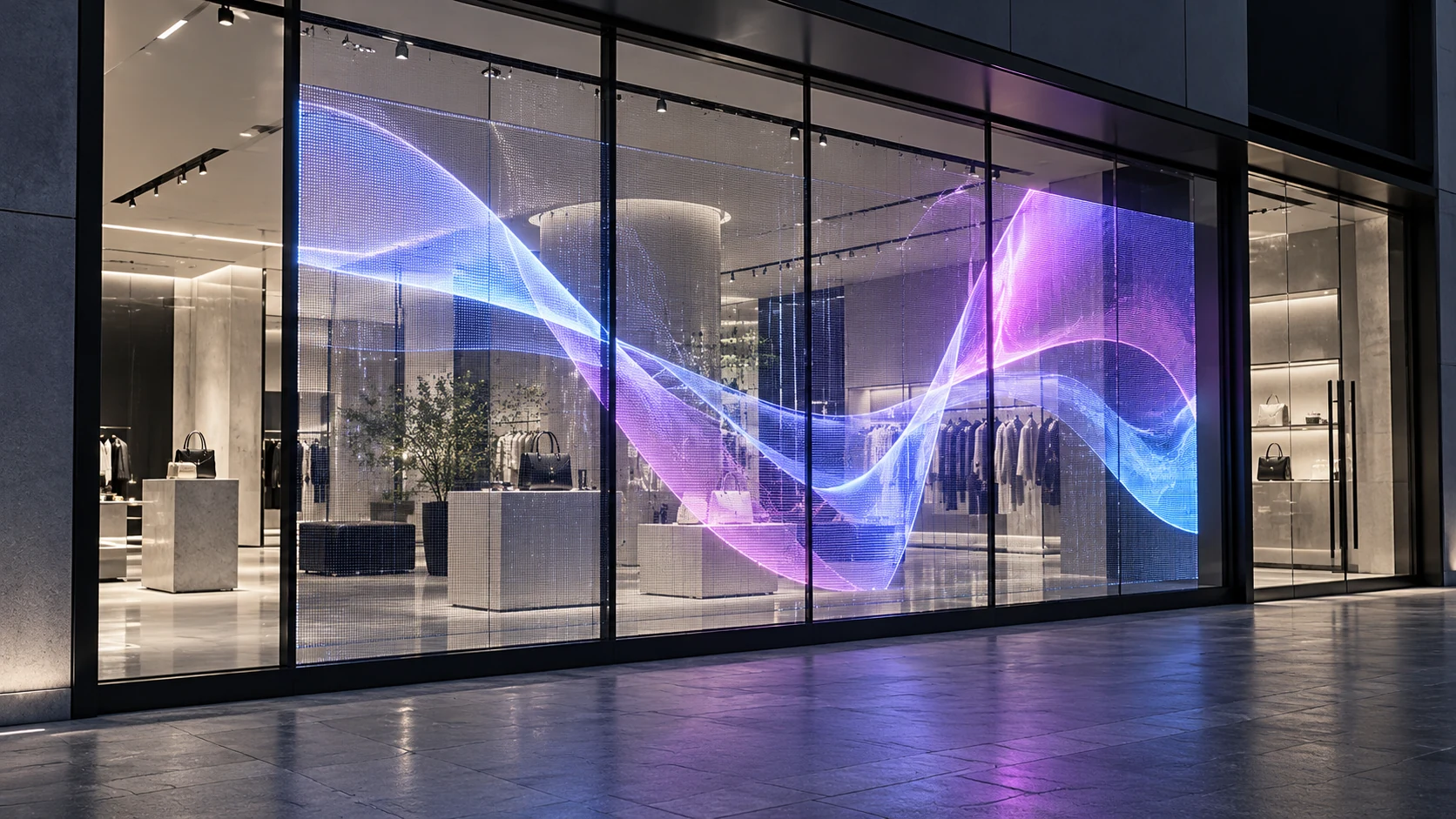
A transparent led screen is a display panel built from thin LED strips or mesh that lets light and background pass through while still showing bright digital content. Unlike a standard LED video wall, which is a solid, opaque panel, a transparent led wall has gaps between the diodes so people on either side can see through it.
Most commercial units fall into three builds. Adhesive LED film sticks directly onto existing glass. Strip or mesh panels mount inside a frame, often on window facades or as freestanding dividers. Rigid transparent LED cabinets combine both approaches for permanent installations.
Transparency levels typically sit between 60% and 90%, and outdoor units can hit brightness of 3,000 to 6,000 nits to stay visible in daylight, per the same Dynamo LED guide referenced above. Pixel pitch, the distance between LED points, ranges from around 2.6mm for close viewing to 20mm or more for large facades viewed from a distance.
When Does a Transparent LED Screen Make the Most Sense?
A transparent LED screen display earns its cost when a space needs both visibility through the glass and a moving digital message. Below are the situations where that trade-off pays off, and a few where it doesn’t.
Storefronts and Retail Windows
This is the most common use case for a transparent led video wall. A retail window has to do two jobs at once: show off merchandise and catch the eye of someone walking past.
A 2007 study commissioned by 3M and POPAI, based on over 24,000 shopper observations across four Dutch retail locations, found that 85 percent of shoppers felt dynamic window content improved their impression of the store, and more than half recalled a specific promotional message without being prompted. That’s the exact effect a transparent led screen is built to create: content that moves without hiding the merchandise behind it.
A well-known real example is Canada Goose’s flagship store on Regent Street in London, where a 5 by 2.5 metre transparent LED display with a 2.6mm pixel pitch was installed to run daylight-bright content in the storefront window, based on public project details from Dynamo LED Displays. The screen sits in the glass without blocking the view of the products staged behind it.
Separately, research cited by Spectrio from a FedEx-commissioned study found that 76 percent of consumers said signage drew them into a store, and 68 percent said a sign influenced a purchase. A transparent led screen display gives retailers a way to run that kind of messaging without covering the window entirely.
Corporate Lobbies and Glass Partitions
Office lobbies increasingly use a transparent led wall as a room divider or feature wall that still lets daylight and sightlines through. It works well where a company wants to show branding, wayfinding, or event content without turning a glass lobby into a solid wall.
The trade-off here is subtler than in retail. A lobby doesn’t need daylight-level brightness, so indoor units running 1,000 to 1,500 nits are usually enough, which keeps power draw and cost down.
Museums, Showrooms, and Exhibition Spaces
Museums use transparent led screens to layer digital information over physical objects such as cars, artifacts, or architectural models, without hiding the object itself. A showroom for a car brand can run spec sheets or ambient video across a glass panel positioned in front of the vehicle.
This only works when the content is designed for it. Dense text or busy video competes with whatever is behind the glass, so the best exhibition use of a transparent led video wall keeps graphics simple and lets the physical object stay the visual anchor.
Stadiums, Concourses, and Entertainment Venues
Concourse glass walls and suite windows in stadiums sometimes use led transparent screen panels to show scores, replays, or sponsor content while keeping views of the field or the crowd. Because these installations often face heavy foot traffic and long duty cycles, the panel needs a higher IP rating and a proven refresh rate, since flicker is more noticeable on large video content than on static signage.
When It's Not the Right Choice
A transparent led screen is the wrong pick in a few common situations:
- The space has no need for a see-through view, an opaque LED wall is cheaper per nit of brightness and easier to source.
- The budget can’t absorb the premium; transparent panels typically cost more per square metre than solid LED walls of the same size.
- The glass structure wasn’t engineered to carry extra mounting weight, which matters more for rigid panel systems than for adhesive film.
- The room is dim and quiet, where a printed graphic or a simple poster does the job without the ongoing power and maintenance cost of an LED system.
How Much Does a Transparent LED Video Wall Cost?
Cost depends heavily on the build type and location. In the UK, adhesive LED film starts around £2,000 per square metre, while modular transparent LED panels run £5,000 or more per square metre before VA.
Three factors move the price the most:
- Pixel pitch. Finer pitch, meaning LEDs packed closer together, costs more because it needs more components per square metre.
- Brightness rating. Outdoor-rated panels built for 5,000+ nits cost more than indoor units running at 1,000 to 1,500 nits.
- Installation complexity. Retrofitting film onto existing glass is far cheaper than a structural install requiring new framing or reinforced glazing.
One market analysis estimated the global transparent LED display market at $301.1 million in 2024, projected to reach $540.7 million by 2032. That growth points to more manufacturers entering the space, which should push prices down over time as competition increases.
Transparent LED Screen vs Other Display Options
Here’s how a transparent led screen compares against the alternatives most commercial buyers are also considering.
Feature | Transparent LED Screen | Standard LED Video Wall | Window Film / Vinyl Graphic | Projection onto Glass |
See-through visibility | Yes, 60-90% | No | Partial, static only | Yes |
Content is dynamic/video | Yes | Yes | No | Yes |
Daylight visibility | Strong (3,000-6,000 nits) | Strong | N/A | Weak, needs low light |
Typical cost per sqm | Higher | Moderate | Low | Low to moderate (hardware only) |
Maintenance | Moderate, remote monitoring common | Moderate | Low, occasional replacement | Higher, bulb/lens upkeep |
Best fit | Storefronts, glass facades, lobbies | Solid walls, stages, arenas | Budget storefront graphics | Dim indoor spaces only |
A led transparent screen sits in a specific niche: it’s the only option on this list that combines full-motion digital content with genuine see-through visibility in daylight conditions. Film graphics are cheaper but static. Projection is cheap on hardware but struggles in daylight and needs a clean surface to land on.
What to Check Before You Commit to a Transparent LED Wall
Structural Support
Viewing Distance and Pixel Pitch
Power and Heat
Higher brightness panels draw more power and generate more heat, which matters in a sealed glass lobby without much airflow. Ask the supplier for actual wattage per square metre at your target brightness level, not just a peak spec.
Content Design
A transparent led screen display looks worse than a plain window when the content wasn’t designed for a see-through surface. High-contrast graphics with simple backgrounds read far better than dense video, since whatever sits behind the glass becomes part of the image.
Maintenance Access
Front-serviceable panels let a technician swap a failed module from the accessible side of the glass. Rear-access panels need room behind the installation, which isn’t always available on a street-facing storefront.
whatever sits behind the glass becomes part of the image.
Final Thoughts
A transparent led screen makes sense in one specific situation: when a business needs a glass surface to carry moving digital content without giving up the view through it. Storefronts, lobbies, and museum exhibits fit that description. A back-office conference room or a budget retail unit usually doesn’t.
If you’re weighing this for a specific space, start by measuring the glass, checking what it can structurally support, and getting real wattage and brightness numbers from a supplier rather than marketing specs alone. That’s the information that actually decides whether a transparent LED wall is worth the cost, not the general pros and cons.
Frequently Asked Questions
How long does a transparent LED screen last?
Most commercial-grade panels are rated for 100,000 hours of use or more under normal operating conditions, based on manufacturer specs commonly listed for transparent LED products. That works out to well over a decade of typical daily use before brightness degrades enough to need replacement.
Can a transparent LED screen be installed on existing glass without replacing it?
Yes, adhesive LED film is designed specifically for this. It applies directly to existing windows or glass partitions, which makes it the faster and cheaper route compared to structural panel systems that require new framing.