
TL;DR
- A flexible LED screen bends by hand into waves, S-curves, and column wraps. A curved LED video wall uses pre-curved cabinets or modules for a fixed, engineered radius.
- Flexible panels suit retail, museums, and event spaces where the shape changes often. Curved cabinets suit permanent installs like control rooms, lobbies, and boardrooms.
- Pixel pitch, bend radius, and brightness all shift the decision. Some flexible modules bend to a radius as tight as 637 mm, while curved cabinet systems hold a fixed architectural curve for years.
- A true foldable LED screen is still a niche, mostly custom, option rather than an off-the-shelf standard.
- Budget, viewing distance, and how often the display needs to change shape usually decide the answer faster than any spec sheet.
A flexible LED screen and a curved LED video wall solve two different problems, even though they look similar in a showroom. One bends on site to fit an unusual shape. The other ships already curved to hold a fixed architectural line. Picking the wrong one means either overpaying for flexibility you never use, or locking yourself into a curve you can’t change later.
This guide breaks down how each technology actually works, where the money goes, and which one fits specific commercial spaces: retail floors, corporate lobbies, control rooms, and event stages.
What Is a Flexible LED Screen, Exactly?
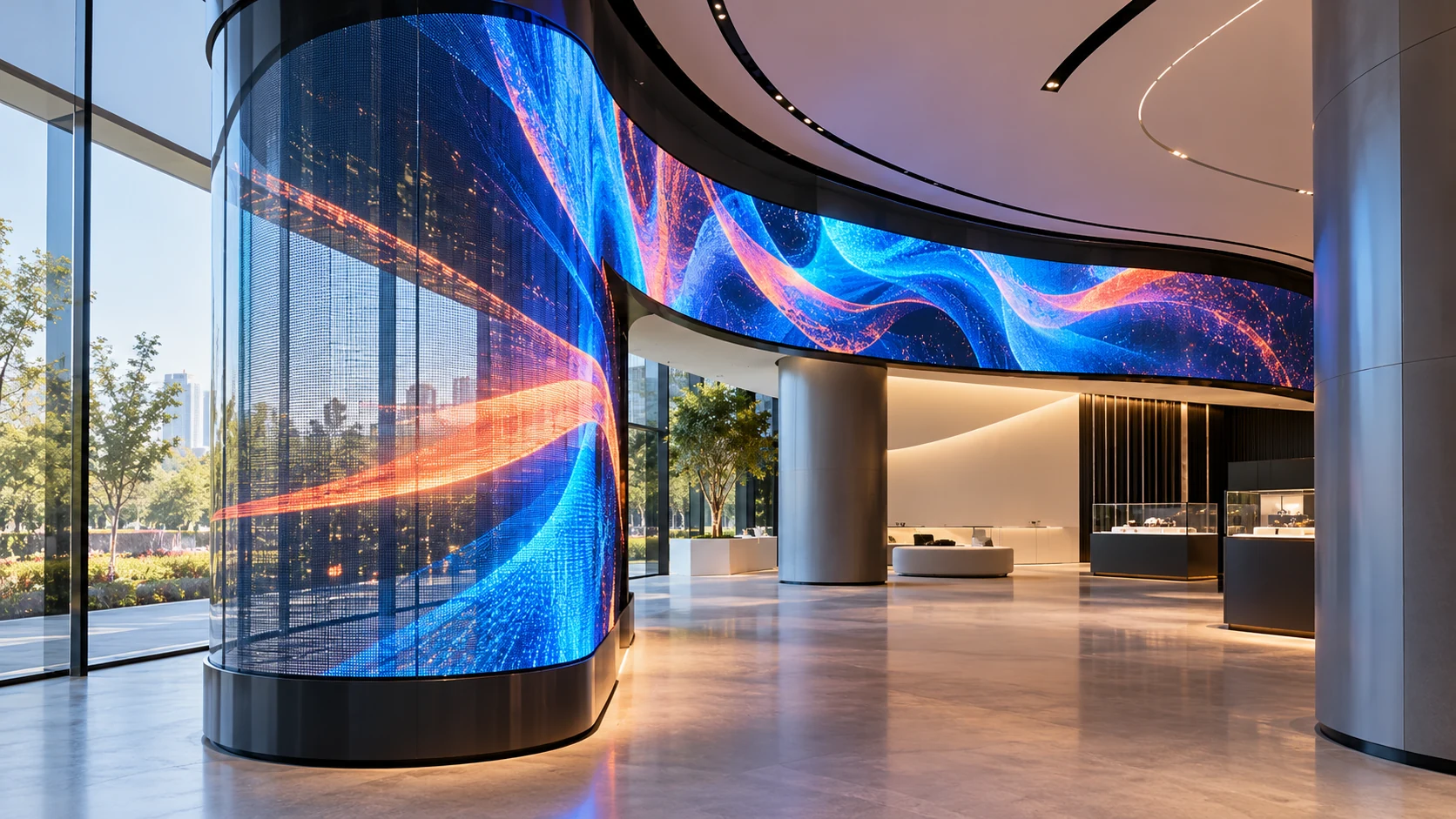
A flexible LED screen is a display built on a soft, bendable circuit board instead of a rigid cabinet, so installers can curve it by hand on site into waves, S-shapes, or wraps around columns. The bendable PCB layer lets the panel flex in both directions rather than holding one fixed shape.
A typical indoor flexible module runs around 10 mm thick and weighs close to 0.2 kg per unit, with pixel pitches commonly between 2.5 mm and 4 mm for close-up commercial use the module supports center and diagonal bending for curved, cylindrical, and custom-shaped screen projects. Because the modules are cabinet-free, they get installed straight onto a shaped frame, whether that frame is a convex column, a concave archway, or a free-form wave.
Common places you’ll find a flexible LED display screen:
- Shopping mall atriums and brand activation walls.
- Museum exhibits and interactive installations
. - Hotel lobby ceilings and feature columns
. - Concert stages and temporary event structures
.
The appeal is design freedom. If a designer wants a screen that flows around a spiral staircase or drapes over a curved reception desk, a flexible panel is often the only option that physically works.
What Is a Curved LED Screen, and How Is It Different?
A curved LED screen uses cabinets or modules manufactured with a built-in, fixed curve, so the radius is set at the factory rather than bent on site. Instead of a soft, hand-shapeable board, you get a rigid module engineered to a specific concave or convex angle before it ever reaches the venue.
Manufacturers offer this in two forms. The first is a segmented curve, where flat cabinets are angled slightly against each other to approximate a curve, similar to a polygon standing in for a circle. The second is a true smooth curve, where the module itself is pliable enough to form a continuous arc without visible facets. Planar’s CarbonLight CLI Flex line, for example, bends down to a radius as tight as 25 inches or 637 millimeters while staying smooth and free of color shift at the seams.
Curved cabinet systems from brands like LG pair this shape with fine pixel pitches down to around 1.2 mm, running at up to 800 nits, which suits close-range corporate and executive environments such as boardrooms and reception walls. That combination of tight pixel pitch and a fixed architectural curve is what makes a curved LED video wall feel like part of the building rather than a screen bolted onto it.
Flexible LED Screen vs Curved LED Video Wall: Core Differences
Factor | Flexible LED Screen | Curved LED Video Wall |
Shape set during | On-site installation | Factory manufacturing |
Typical bend radius | Adjustable, down to roughly 0.5 m on premium models | Fixed at order time, often 25 in / 637 mm and up |
Best for | Temporary or reconfigurable spaces | Permanent architectural installs |
Common pixel pitch | 1.5 mm to 4 mm | 1.2 mm to 3 mm on premium curved cabinets |
Serviceability | Front or rear, module-based | Usually front-service on fine-pitch models |
Design flexibility | High, can form waves and free-form shapes | Limited to the ordered radius |
Typical use case | Retail, museums, events | Boardrooms, lobbies, control rooms, broadcast |
When Does a Flexible LED Display Screen Make Sense?
A flexible LED display screen makes sense whenever the venue’s shape is unusual, temporary, or likely to change. If the display needs to wrap a column, drape over an arch, or get reconfigured for a different event next quarter, flexibility earns its premium.
Retail and Experiential Spaces
Museums, Exhibits, and Branded Environments
Events and Temporary Installations
When Does a Curved LED Video Wall Make More Sense?
Control Rooms and Command Centers
Corporate Lobbies and Boardrooms
A curved reception wall or boardroom display benefits from a factory-set radius because it’s viewed from largely fixed seating positions. Curved cabinets in this category commonly run 1.25 mm pixel pitch for close-range viewing from around 4 to 6 feet, paired with HDR support for polished presentation and brand content.
Broadcast and Studio Backgrounds
What About Foldable LED Screens? Are They a Third Option?
A foldable LED screen exists, but it’s a narrower category built for portability rather than architectural shaping, and it’s still mostly custom or semi-custom rather than a mainstream product line. Instead of bending into a permanent curve, a foldable panel is engineered to hinge flat for transport and then lock into a rigid shape on site, similar to a folding room divider.
This matters most for touring productions, rental and staging companies, and any team that needs a display to survive repeated setup and teardown without losing calibration. A foldable LED screen trades some of the free-form shaping of a true flexible panel for faster rigging and more predictable alignment between panels, which rental crews often value more than raw bendability.
If your priority is portability and quick setup rather than an organic curved shape, a foldable format is worth asking your integrator about directly, since availability and specs vary a lot between manufacturers.
Cost Comparison: Flexible, Curved, and Standard Flat LED Screens
- Pixel pitch drives price more than curvature does. A 1.2 mm curved cabinet will usually cost more than a 2.5 mm flexible panel, regardless of shape.
- Custom radius orders cost more than catalog options. Standard bend radii that a manufacturer already tools for are cheaper than a one-off curve designed for your specific wall.
- Flexible installs need more labor. Hand-shaping and securing a flexible panel to a custom frame takes longer than racking flat or pre-curved cabinets.
- Service access changes ongoing cost. Front-serviceable panels reduce long-term maintenance labor because technicians don’t need rear access behind a wall or column.
Installation and Maintenance: What Changes With Curves and Bends?
Installation complexity rises with curvature, whether that curve is bent on site or built into the cabinet, mainly because mounting frames, cabling, and service access all need to be planned around the shape instead of a flat grid.
For flexible LED screens, installers typically build or order a custom sheet-metal frame matched to the intended curve, then attach the bendable modules to that frame, often magnetically for easier future removal. Because the shape isn’t fixed by the manufacturer, on-site quality control matters more: uneven tension across the panel can create visible seams or color shift if it’s not mounted carefully.
For curved LED video walls, the radius is already built into the cabinet, so installation resembles a standard rigging job with one extra step: confirming the mounting structure matches the ordered curve before cabinets go up. Front-service designs, common on fine-pitch curved cabinets, let technicians swap a faulty module from the front of the wall without disassembling anything behind it.
A rule worth keeping in mind for either format: the recommended viewing distance for a direct-view LED wall is about seven times the pixel pitch, so a curved boardroom display meant to be viewed from six feet away needs a noticeably finer pitch than a lobby wall viewed from across a room.
Regarding lifespan, direct-view LED technology in general holds up well over time. LED panels typically last roughly twice as long as LCD video walls, running past 100,000 hours before performance degrades, and that figure applies whether the cabinet is flat, curved, or flexible, since the underlying LED components are the same.
How to Decide Between Flexible and Curved for Your Project
Start with one question: will this shape ever need to change? If the answer is yes, a flexible LED screen is worth the premium. If the answer is no, a curved LED video wall usually delivers better image quality and lower long-term cost for the same budget.
From there, walk through these checks:
- Map the physical shape you actually need. A single fixed arc points toward curved cabinets. Waves, S-curves, or wraps around irregular objects point toward flexible panels.
- Set your viewing distance first. Closer viewing distances need finer pixel pitch, which narrows your options in both categories.
- Decide how often the install will change. Permanent architecture favors curved cabinets. Rotating events, seasonal retail displays, or touring shows favor flexible or foldable formats.
- Check service access before you sign off. Confirm whether maintenance happens from the front or the back, since that changes how much clearance you need behind the wall.
- Get real bend radius numbers from the manufacturer. Don’t assume “flexible” means it bends to any shape. Ask for the tightest radius the specific model supports before you finalize the design.
Final Thoughts
A flexible LED screen and a curved LED video wall both solve the same basic problem, fitting a display into a space a flat panel can’t handle, but they get there in opposite ways. One bends on site for shapes that might change. The other arrives pre-curved for architecture that won’t. Match the choice to how permanent your shape actually is, not to which option sounds more impressive on a spec sheet.
If you’re planning a commercial install and aren’t sure which format fits your space, pull your viewing distances and rough dimensions together first, then request quotes from at least two integrators for both a flexible and a curved option at the same pixel pitch. Comparing real numbers side by side will make the decision far clearer than any brochure.