
TL;DR
- Meeting equity means remote and in-room employees get the same chance to speak, be seen, and influence decisions.
- Hybrid meetings usually fail for two reasons: proximity bias and broken audio or video.
- Nearly 96% of executives notice in-office work more than remote work, according to Envoy’s workplace survey, which quietly shapes who gets credit in meetings.
- The right meeting room AV system, better microphones, wider cameras, and one-touch controls, closes most of that gap without changing how anyone works.
- Fixing the room fixes a good chunk of the culture problem, but facilitation habits still matter just as much.
Meetings Are Where Inequity Actually Happens
Most companies talk about hybrid work fairness as an HR issue. It’s actually a meeting room issue. Decisions get made, credit gets handed out, and careers get shaped inside 30-minute calls, and the room’s setup decides who gets heard in them.
This article breaks down what meeting equity means, why so many hybrid meetings quietly leave remote employees behind, and what a proper meeting room AV system actually fixes versus what it can’t.
What Is Meeting Equity?
Meeting equity means every participant, whether they’re sitting at the table or joining from a laptop across the country, has the same ability to speak, be heard, and be seen. It’s not about giving remote workers special treatment. It’s about removing the built-in advantages that in-room attendees get by default.
According to WorkLife’s breakdown of the term, meeting equity became a named concept only after the pandemic forced companies to run meetings with people in two very different physical situations at once. Before that, “meeting fairness” wasn’t really a problem worth naming, because almost everyone was either fully in the office or fully remote.
The term gets used alongside a few related ideas:
- Inclusive meetings: Practices and formats that intentionally give remote and quieter participants room to contribute.
- Conference room solutions: The physical tools (microphones, cameras, displays) that make a hybrid meeting technically possible.
- Proximity bias: The unconscious tendency to favor people who are physically closer to us.
These three ideas overlap constantly. A room can have great conference room solutions installed and still produce an unfair meeting if nobody changes how they run it.
Why Hybrid Meetings Fail Without Meeting Equity
Hybrid meetings fail because the deck is stacked before anyone speaks. Two forces do most of the damage: proximity bias and broken AV. Neither one is intentional, and that’s exactly why they’re hard to catch.
Proximity Bias Runs the Room
In-office employees get noticed more, promoted more, and paid more, often without anyone realizing why. A 2022 Envoy survey found that 96% of executives admit they’re more likely to notice work done in the office than work done remotely.
That bias shows up directly in meetings. In-room employees chat before the call starts, read each other’s body language, and jump in first because they’re already tuned into the room’s rhythm. Remote employees are stuck waiting for a pause that often doesn’t come.
The financial impact is measurable. Employees who worked mostly from home between 2013 and 2020 were 38% less likely to receive a bonus than their on-site peers, according to UK Office for National Statistics data. A separate 2023 study found fully remote workers were 24% less likely to be promoted, despite reporting higher personal productivity than in-office staff.
Leadership already sees this as a real risk. More than four in ten executives in a 10,000-person Future Forum survey ranked inequity between remote and in-office employees as one of their top concerns.
Audio Breaks Down First
Bad audio kills a meeting faster than anything else. People can sit through a blurry camera feed. They can’t sit through a conversation they can’t understand.
Based on a survey conducted by Oxford Systems Integration – L.L.C. 55% of of the people said Poor audio quality was the biggest issue their team faced, followed by Connectivity delays at 25%.
A Shure survey on video conferencing complaints found the most common audio problems were background noise (51%), echo (43%), audio cutting in and out (40%), and audio that was simply hard to hear (40%). None of those are rare edge cases. They’re what a normal week looks like in an underequipped conference room.
Rooms Were Built for a Different Era
Most conference rooms were designed before hybrid work was the default, and it shows. According to data referenced from Cisco and reported by AV Access, fewer than 15% of the world’s 87 million meeting spaces are properly equipped for video conferencing.
That gap causes delays before a meeting even starts. Owl Labs’ hybrid work research, summarized by The Network Installers, found that 77% of employees have lost time to meetings that started late because of technical issues, and 67% have given up trying to set up video technology because it was too difficult. The same report found 72% of remote participants struggle to see everyone’s faces clearly, which means they’re also missing the visual cues that carry half of a normal conversation.
What It Costs When Meeting Equity Is Missing
Meeting inequity has a cost attached to it. The average employee now spends close to 12 hours a week in meetings, and meeting time overall costs around $29,000 per employee per year once you count wasted time and follow-up work.
Here’s what tends to happen when a company ignores meeting equity for too long:
- Remote and hybrid employees stop speaking up, because they’ve learned it doesn’t change the outcome.
- Good ideas get lost simply because the person raising them wasn’t in the room.
- Promotion and pay decisions quietly skew toward whoever shows up most often in person.
- Trust in leadership erodes, since employees notice the pattern even when managers don’t.
- Meetings run longer, because people keep repeating themselves over bad audio.
None of these show up on a single dashboard. They show up slowly, in turnover numbers and engagement scores, months after the actual meetings that caused them.
How AV Fixes Meeting Equity
A well-designed meeting room AV system removes the technical excuses that let proximity bias thrive. It won’t fix a bad meeting culture on its own, but it takes away the easiest reasons for remote employees to get overlooked.
Microphones That Reach Every Seat
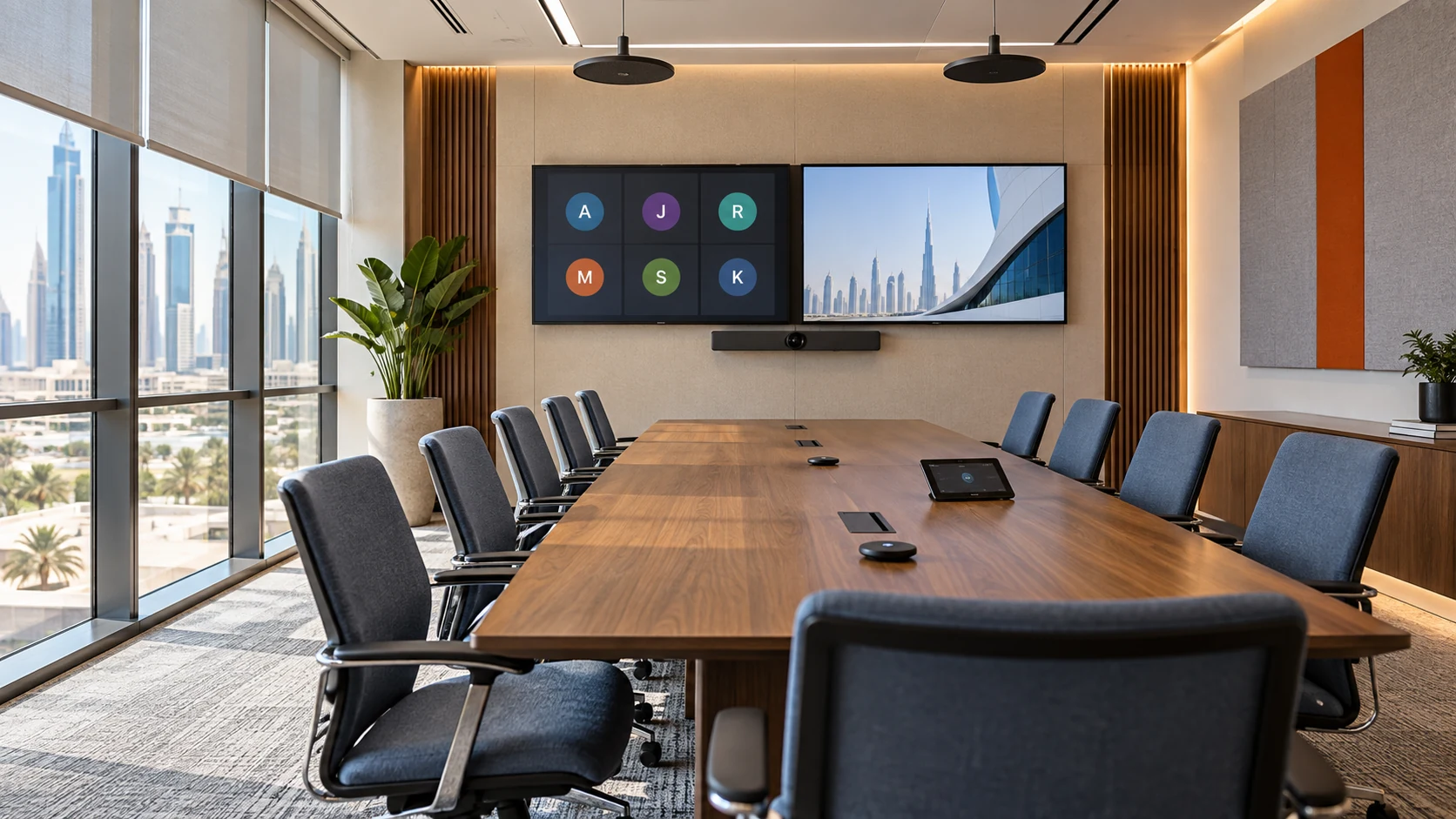
A single speakerphone in the middle of a table cannot pick up someone sitting at the far end, let alone someone speaking softly. Ceiling arrays and beamforming microphones capture voices evenly across the whole room, so remote participants hear the person at seat one just as clearly as the person right next to the camera.
This matters more than most teams expect. Since background noise and audio interruption are among the top complaints in hybrid meetings, upgrading microphone coverage alone removes a big share of the daily friction.
Cameras That Show the Whole Room, Not Just the Table
A fixed, wide-angle camera pointed at an empty table tells a remote employee nothing about who’s talking or how they’re reacting. Speaker-tracking cameras that follow whoever is speaking, or wide-angle systems that frame every face individually, give remote attendees the same visual information as someone sitting across the table.
This directly addresses the 72% of remote workers who report struggling to see faces clearly during hybrid calls. Facial expressions carry tone, hesitation, and agreement. Without them, remote employees are reading a transcript, not attending a meeting.
One-Touch Systems Remove the Friction
Complicated setups punish everyone, but they punish remote and hybrid work the hardest, since a failed connection means someone doesn’t get to participate at all. Simple, one-touch join systems cut the setup time that causes late starts.
That late-start problem is bigger than it sounds. Flowtrace’s 2025 data, also reported by The Network Installers, found that 50% of all meetings now start late, and room-level setup failures are a leading cause.
Displays and Content Sharing That Include Everyone
When only in-room attendees can see a shared screen clearly, or when wireless sharing requires plugging in a specific cable, remote participants fall behind on context. Systems that mirror the same screen resolution and content to every participant, in-room and remote, keep the conversation on equal footing.
Conference Room Solutions: Old Setup vs. Equity-Focused Setup
| Element | Traditional Conference Room | Equity-Focused Meeting Room AV System |
|---|---|---|
| Microphone | Single speakerphone on the table | Ceiling or beamforming array covering the full room |
| Camera | Fixed wide shot of the table | Speaker-tracking or multi-zone camera framing individuals |
| Meeting start | Manual cable plugging, app switching | One-touch join across platforms |
| Content sharing | Wired connection, in-room only | Wireless sharing visible at the same quality remotely |
| Remote participant view | Small, distant, hard to read | Framed close-up with clear audio pickup |
| Typical result | Remote staff talk less, get interrupted more | Remote and in-room staff participate at similar rates |
Inclusive Meetings Take More Than Hardware
- Open the meeting by directly inviting remote attendees to speak first on at least one topic.
- Keep cameras on for in-room attendees too, so the interaction feels balanced rather than remote employees being the only ones on display.
- Share the agenda and any documents before the meeting, not during it, so no one is reading and listening at the same time.
- Rotate who facilitates, instead of always defaulting to whoever is in the office that day.
- Document decisions in writing right after the meeting, so no one has to rely on being in the hallway conversation that happened afterward.
A Meeting That Shows the Difference
Picture a weekly product review with six people in a conference room and three joining remotely. The room has one ceiling speaker and a laptop propped against a monitor for video. The remote employees can hear the person closest to the laptop clearly, but voices from the far end of the table come through muffled.
Ten minutes in, one remote employee raises a concern about a launch date. Nobody in the room quite catches it over the room’s usual background hum, and the conversation moves on before it gets addressed. Later, in a hallway conversation after the meeting ends, two in-room employees end up deciding on the actual date, without any input from the people who couldn’t be heard.
Now picture the same meeting with a ceiling microphone array and a speaker-tracking camera. The remote employee’s concern comes through as clearly as if they were sitting at the table, the camera frames them the moment they start talking, and the facilitator pauses to address the point before moving forward. Nothing about the meeting’s agenda changed. The only difference was whether the room let everyone actually participate.
How to Choose a Meeting Room AV System
Not every room needs the same setup. A small huddle room and a 20-person boardroom have different coverage needs, but a few questions apply everywhere:
- Does the microphone system cover every seat, including corners and the far end of the table?
- Can the camera frame individual speakers, or only a wide static shot?
- How many steps does it take for someone to start a meeting from a cold start?
- Does the system work the same way across the video platforms your teams actually use?
- Can IT monitor and troubleshoot the room remotely, or does every issue need someone physically present?
Rooms that answer these well tend to produce meetings where remote and in-room voices carry roughly equal weight, which is the actual measure of meeting equity working as intended.
Final Thoughts
Meeting equity isn’t a policy you announce once. It’s decided every day by whether your rooms let remote employees participate as easily as the people sitting at the table. Start with the room your team uses most, walk through the questions in the AV checklist above, and fix whichever piece is currently the weakest link, whether that’s audio coverage, camera framing, or how long it takes to actually start the call.
Frequently Asked Questions
What is meeting equity in simple terms?
Can better AV equipment really reduce proximity bias?
It reduces the technical part of the problem. Clear audio and better camera framing stop remote employees from being ignored simply because they were hard to hear or barely visible. It won’t remove bias from someone’s judgment on its own, so facilitation habits still need to change alongside the hardware.
What's the single most important upgrade for a hybrid conference room?
Audio, almost every time. People can follow a meeting through a slightly blurry camera. They can’t follow one they can’t hear clearly. Fixing microphone coverage tends to solve more complaints than any other single change.
How much does poor meeting equity actually cost a company?
It’s hard to put one number on it, but the pieces add up: lost productivity from repeated conversations, turnover from employees who feel overlooked, and skewed promotion decisions that push out capable remote talent. Combined with the average $29,000 per employee per year already spent on meeting time, inefficient hybrid meetings compound an existing cost.
Do small companies need the same AV setup as large enterprises?
No. A five-person huddle room doesn’t need the same microphone coverage as a large boardroom, but it still needs audio that reaches every seat and a camera that shows more than a static wide shot. The scale changes. The core requirement, that remote participants hear and see clearly, doesn’t.