
TL;DR
- Audio fails hybrid meetings more than video does, so fix microphone and speaker coverage before anything else.
- Pick certified, interoperable hardware over a single flashy device so your room doesn’t get boxed into one platform.
- Route everything through one central room control platform so IT can monitor, update, and fix rooms without walking to each one.
- Build the boring stuff right: wired network, proper cabling, and enough power, since this is what breaks first.
- Plan a 3 to 5 year refresh cycle instead of waiting until a room fails during a client call.
Most conference rooms were built for a world where everyone sat at the same table. That world is gone. Now a room has to work for the six people in the chairs and the four people joining from somewhere else, and most rooms still aren’t built for that job.
This guide walks through what actually makes meeting room AV last: the audio and video gear, the software layer that manages it, the network underneath it, and the habits that shorten a room’s useful life. No vendor pitch, just the decisions that hold up over time for real audio visual systems in real offices.
Why Does Meeting Room AV Go Out of Date So Fast?
Meeting room AV goes out of date fast because the way people meet changed faster than the rooms did. A speakerphone and a TV worked fine when everyone was in the building. Add remote participants, and the same setup exposes every weak point in the room’s audio, video, and network.
What Changed Since Rooms Were Last Designed
Hybrid work is no longer the exception, it’s the baseline. Microsoft’s 2026 Work Trend Index found that 73% of enterprise meetings now include at least one remote participant, yet most conference rooms were designed years before that shift happened. A single center-table speakerphone and a static ceiling camera were never built to handle a room where half the voices need to travel to a screen somewhere else.
That mismatch shows up immediately. Meetings start late, remote participants strain to hear, and someone ends up hosting the call from their laptop because the room system failed again. The old model of buying a screen and a phone and calling it done simply doesn’t match how people actually work now, which is exactly why so many offices are rethinking their meeting room solutions from the ground up instead of patching the same gear year after year.
The Real Cost of Outdated Conference Room Technology
Outdated conference room technology costs real money, not just frustration. Owl Labs’ 2025 State of Hybrid Work Report found that 77% of employees have lost time waiting for meetings that started late because of technical problems, and more than two-thirds gave up trying to set up video technology at least once because it was too complicated.
That wasted time adds up across an organization. Meeting inefficiency, including the drag from bad room technology, has been estimated at close to $29,000 per employee per year in one large dataset covering 2.2 million meetings. When a room’s conference room technology can’t keep up, the cost shows up on every calendar, every day.
What Does "Future-Proof" Actually Mean for a Meeting Room?
Future-proofing a meeting room means choosing gear and infrastructure that can absorb changes in platforms, headcount, and features without a full rebuild. It’s not about buying the newest camera on the market. It’s about avoiding choices that lock the room into one narrow use case.
A future-proof room usually shares a few traits:
- It runs on hardware certified for more than one video platform, so switching from Zoom to Teams (or the reverse) doesn’t mean ripping out equipment.
- It’s built on wiring and network capacity with headroom for tomorrow’s bandwidth needs, not just today’s.
- It’s managed centrally, so updates and fixes don’t require a technician to visit every single room.
- It scales up or down in components (microphones, cameras, displays) rather than forcing a full swap when the room’s use case changes.
Good meeting room solutions are less about any single gadget and more about the system working together. A $6,000 camera bolted onto a shaky network and a five-year-old speakerphone is still a weak room.
Start With Audio, Not Video
Audio should be the first thing you fix in any meeting room, because bad sound wrecks a meeting faster than bad video ever does. Video quality issues are annoying. Audio quality issues make the meeting impossible to follow.
The data backs this up clearly. A 2025 video conferencing study found that 66% of participants say poor audio is more distracting than poor video resolution. Remote participants can forgive a slightly blurry camera feed. They cannot forgive not being able to hear who’s talking.
Ceiling Microphones vs Table Microphones
Ceiling microphone arrays generally outperform table mics in rooms with more than six or seven seats. A single table puck struggles to pick up voices from the far end of a long table evenly, while a ceiling array with multiple pickup zones catches every seat without anyone needing to lean toward a device.
Table mics still make sense in smaller huddle rooms, where the distance between speaker and microphone is short and consistent. For a 4 to 6 person space, a good table mic paired with a video bar often does the job without the cost of a ceiling install.
I worked through this exact tradeoff with a 9-person conference room that had a single table mic left over from years earlier. Remote participants kept asking people at the far end to repeat themselves. Swapping in a two-zone ceiling mic, without touching the camera or display at all, fixed the complaint within one meeting. That’s the kind of low-cost, high-impact change that gets missed when audio visual systems are budgeted as one lump sum instead of by component.
Speaker Coverage for Every Seat
Every seat in the room needs to hear the same audio level, not just the seats closest to the screen. Long, narrow rooms are the worst offenders here: people at the back often can’t hear remote participants clearly because a single soundbar wasn’t designed to throw sound that far.
Picture a 14-seat boardroom with one soundbar mounted under the display. The first six rows hear fine. The back of the room strains through every meeting. That’s a design failure, not a hardware failure, and it’s fixed with distributed speakers, not a louder single unit.
Choose Cameras That Adapt to the Room, Not Just the Moment
Camera systems should be chosen for how the room will be used over years, not for how a demo looked in a showroom. A fixed wide-angle camera is fine for a small huddle room. It falls apart in a large room where people sit far from the lens and framing quality drops off fast.
PTZ (pan-tilt-zoom) cameras and AI-framing cameras solve different problems. PTZ cameras let a host manually or automatically track a speaker across a large room. AI-framing cameras, now common in certified room bars from vendors like Poly and Logitech, automatically create individual tiles for each person in the room so remote participants can actually see faces instead of a wide, flat shot of a table.
The mistake many offices make is installing the same camera type in every room regardless of size. A 4-person huddle room and a 16-person boardroom have completely different framing needs, and treating them the same wastes budget in one direction or leaves a gap in the other.
Build Around a Real Meeting Room Management System
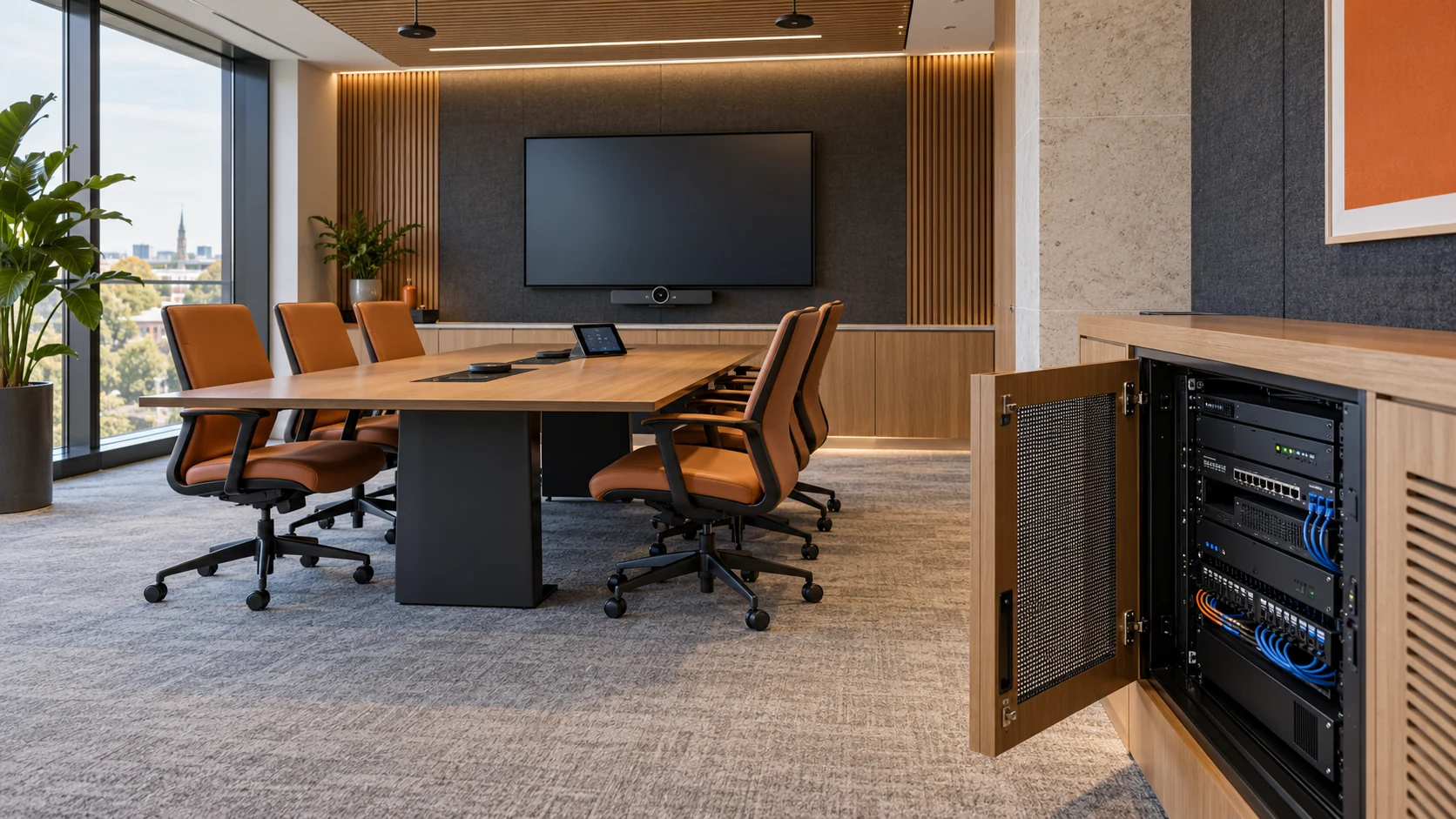
A proper meeting room management system is what turns a pile of AV hardware into something IT can actually support at scale. Without one, every fix requires someone physically walking into the room, and every update has to be applied device by device.
Why Platform Lock-In Hurts Later
Locking a room into one vendor’s closed ecosystem limits your options the moment your organization’s needs change. Certified hardware ecosystems from Microsoft Teams Rooms and Zoom Rooms now overlap significantly, with devices from Logitech, Poly, Yealink, and Neat certified for both platforms and re-imageable between them with a firmware change. That flexibility matters if your company ever switches its primary meeting platform, merges with another company running a different one, or simply wants to negotiate better licensing terms later.
Choosing hardware inside a certified, cross-compatible ecosystem protects that flexibility. Choosing a proprietary, single-purpose box does not.
Remote Monitoring and Scheduling in One Place
Centralized monitoring is what makes a meeting room management system worth the setup effort. IT teams should be able to see room health, firmware status, and usage data from a single dashboard rather than checking each room individually.
This matters more than it sounds. Organizations that standardize their room management report meaningful drops in support tickets tied to conference room technology, simply because problems get caught and fixed before someone walks into a broken room five minutes before a client call. A good management platform also handles scheduling display panels outside each door, so people stop wandering the hallway looking for an open room.
I’ve seen this play out in a mid-size office with about twenty meeting rooms. Before central monitoring was added, facilities staff only found out a microphone had failed when someone complained after a client call went badly. Once the rooms sat on one dashboard, the same failing microphone showed up as a health warning two days earlier, before it ever affected a real meeting.
Wiring, Bandwidth, and the Infrastructure Nobody Notices
The infrastructure behind a meeting room matters as much as the hardware inside it, and it’s the part most offices underspend on. A brand-new camera and microphone array will still stutter and drop calls if the network underneath can’t support it.
Network Readiness for Modern Audio Visual Systems
Wired connections beat Wi-Fi for meeting room AV, full stop. Guidance for enterprise room deployments generally calls for wired gigabit Ethernet rather than Wi-Fi, with bandwidth needs running from around 10 to 20 Mbps per room and up to 30 Mbps for larger gallery-view calls. Wi-Fi introduces the kind of latency and packet loss that shows up as frozen video and dropped audio exactly when it’s most disruptive.
If your building’s network closet hasn’t been touched since before hybrid work became standard, that’s often the actual bottleneck, not the camera or the speaker.
Cabling and Power Standards Worth Planning For
Cata cabling is a reasonable baseline for new installs, with fiber runs considered for larger rooms or longer distances back to a network closet. Skipping this step to save money on a build-out is one of the most common reasons a “future-proof” room needs rewiring within two years. Good audio visual systems are only as reliable as the cable behind the wall, and that’s not a place to cut corners. Power matters too: dedicated circuits for displays, compute units, and ceiling microphones prevent the flickering and reboots that come from overloaded outlets shared with other office equipment.
Room Tier Comparison: What to Expect at Each Level
Different rooms need different levels of investment, and matching the tier to the actual use case avoids both overspending and underspending. Here’s a rough breakdown of what separates entry-level, standard, and advanced meeting room solutions.
| Feature | Entry (Huddle Room) | Standard (Mid-Size Room) | Advanced (Boardroom) |
|---|---|---|---|
| Typical capacity | 2 to 4 people | 5 to 10 people | 10+ people |
| Microphone type | Built-in bar mic | Table mic or small ceiling array | Multi-zone ceiling array |
| Camera | Fixed wide-angle or single AI bar | AI-framing bar with auto-zoom | Multiple PTZ or panoramic cameras |
| Display | Single screen | Single large display | Dual or triple displays |
| Network | Wired, standard switch port | Wired gigabit, dedicated VLAN | Wired gigabit with fiber backbone option |
| Management | Basic remote monitoring | Full room management system | Full room management system with analytics |
| Typical refresh cycle | 3 to 4 years | 4 to 5 years | 5 to 7 years |
Use this as a starting point, not a rulebook. A heavily used 6-person room that hosts client calls every day may deserve advanced-tier audio even if the headcount looks like a standard room.
Room usage patterns matter more than square footage. A rarely booked overflow room can stay entry-tier for years without complaint, while a small room that’s booked back to back for external sales calls deserves the same audio investment as a much bigger space. Base the tier on how often a room faces external, high-stakes calls, not just on how many chairs fit inside it.
How Often Should You Actually Refresh Meeting Room AV?
Most organizations should plan a meaningful refresh every 3 to 5 years, with smaller component upgrades in between. Full teardown-and-rebuild cycles are expensive and disruptive, so the goal is modular upgrades that extend the room’s life without starting over.
A practical approach looks like this:
- Year 1 to 2: monitor usage data and support tickets to catch weak spots early.
- Year 3: replace the components showing the most wear, often microphones and cameras, before displays or cabling.
- Year 5: reassess the whole room against current certification requirements and room size needs.
Rooms that sit on a proper monitoring and scheduling platform make this easier, because usage and health data tell you which rooms actually need attention instead of guessing.
Common Mistakes That Shorten the Life of a Meeting Room
A few repeated mistakes are behind most conference room technology that ages badly. Avoiding these costs less than fixing them later.
Buying the display first. Teams often start room planning with the screen because it’s the most visible part of the room. Audio and network infrastructure should come first since they affect every meeting, while the screen mostly affects how content looks.
Ignoring room acoustics. Glass walls and hard floors bounce sound around a room and defeat even a good microphone array. A modest investment in acoustic panels often does more for call quality than an upgraded microphone.
Skipping certification. Non-certified hardware, even from a well-known brand, can cause echo, dropped connections, and failed firmware updates on platforms like Teams Rooms or Zoom Rooms. It might work fine in testing and then fail under real daily load.
Treating every room the same. A 4-person huddle space and a 14-person boardroom need different microphone coverage, camera framing, and speaker placement. Copy-pasting one room’s spec sheet across the whole office wastes budget somewhere.
No plan for AI features. AI-powered transcription, summaries, and action item extraction are becoming standard across major platforms, but their accuracy depends directly on clean audio input. A poor microphone setup undermines even the best AI features, no matter how advanced the software gets.
Final Thoughts
Future-proofing a meeting room isn’t about chasing the newest camera or the flashiest feature list. It’s about getting the fundamentals right: audio that reaches every seat, hardware that isn’t locked to one platform, a network that can carry the load, and a meeting room management system that lets IT catch problems before they interrupt a meeting.
Start with the room your team complains about most. Audit its audio setup, check whether its hardware is certified, and see whether it’s wired into any kind of central management. That one room will usually tell you exactly where the rest of your meeting room solutions need attention next.
Frequently Asked Questions
How much should a company budget for future-proof meeting room AV?
Budgets vary widely by room size and tier, generally running from a few thousand dollars for a small huddle room to tens of thousands for a full boardroom with modular components, displays, and professional installation. The safest approach is to budget by room tier rather than a flat number across every space in the building.
Do I need to pick one video platform before choosing hardware?
It helps, but it’s not mandatory anymore. Many certified devices from vendors like Logitech, Poly, Yealink, and Neat now work across both Microsoft Teams Rooms and Zoom Rooms, so choosing cross-certified hardware keeps your options open even if the platform decision changes later. Licensing costs for both platforms tend to land in a similar range per room per month, so the hardware decision usually matters more than the software one.
What's the single most important upgrade for an outdated conference room?
Audio, almost every time. Poor sound quality causes more meeting frustration than poor video, so a microphone and speaker upgrade usually delivers the biggest improvement for the smallest investment compared to a new camera or display.
Can I upgrade an existing room instead of replacing everything?
Yes, and it’s usually the smarter move. Many rooms can be upgraded by swapping in certified microphones, cameras, or compute modules while reusing existing displays and cabling, as long as the underlying network can support the new load.
How does a meeting room management system actually save money?
It reduces the two most expensive problems in room AV: unplanned IT visits and undetected equipment failures. Centralized monitoring flags a failing microphone or a firmware issue before it interrupts a real meeting, and it cuts down the support tickets that come from staff fumbling with broken audio visual systems room by room.