
TL;DR
- Ceiling microphones provide wider voice coverage and keep conference tables free from cables and hardware.
- Table microphones are easier to install and often cost less, making them a good choice for smaller meeting rooms.
- Hybrid meeting spaces usually benefit more from ceiling microphone systems because participants can speak from anywhere in the room.
- Room size, seating layout, budget, and future expansion plans should all influence your decision.
- This guide compares both options so you can choose the right microphone system for your conference room.
Clear audio is the foundation of every productive meeting. Whether your team is brainstorming in the office or collaborating with remote colleagues, people need to hear every conversation without asking others to repeat themselves. Choosing the right microphone system can make the difference between a smooth meeting and one filled with interruptions.
If you’re deciding between a ceiling microphone meeting room setup and table microphones meeting room configuration, there isn’t a universal answer. The best option depends on your room size, seating arrangement, meeting style, and long-term technology plans.
This guide explains how ceiling and table microphones work, compares their strengths, and helps you determine which solution best fits your conference room.
Ceiling Microphones vs Table Microphones: Which Performs Better?
The table below compares the two options across the areas businesses care about most.
Feature | Ceiling Microphones | Table Microphones |
Audio coverage | Covers the entire room | Best for nearby participants |
Room appearance | Hidden above the ceiling | Visible on the conference table |
Installation | Requires professional installation | Quick and straightforward |
Seating flexibility | Excellent | Best with fixed seating |
Hybrid meetings | Very good | Good in smaller rooms |
Cable management | Minimal visible cables | May require cable management |
Best suited for | Medium to large conference rooms | Small to medium meeting rooms |
Initial investment | Higher | Lower |
If your conference room regularly hosts hybrid meetings or uses flexible seating, ceiling microphones generally provide better long-term value. If meetings follow the same layout every day, table microphones remain a practical option.
Why does audio quality matter in a conference room?
Audio quality has a bigger impact on meeting productivity than many businesses realize. When participants struggle to hear each other, conversations slow down, misunderstandings increase, and remote attendees often miss important details.
Hybrid work has also changed how conference rooms are used. Instead of supporting only in-person discussions, meeting spaces now connect employees, clients, and partners across multiple locations. That means microphone performance has become just as important as displays and cameras.
Modern conference rooms need microphone systems that can:
- Capture every speaker clearly.
- Reduce background noise and echo.
- Support video conferencing platforms.
- Adapt to different seating arrangements.
- Deliver consistent audio for both in-room and remote participants.
Choosing the right microphone helps meetings feel more natural and keeps everyone engaged throughout the discussion.
What is a ceiling microphone?
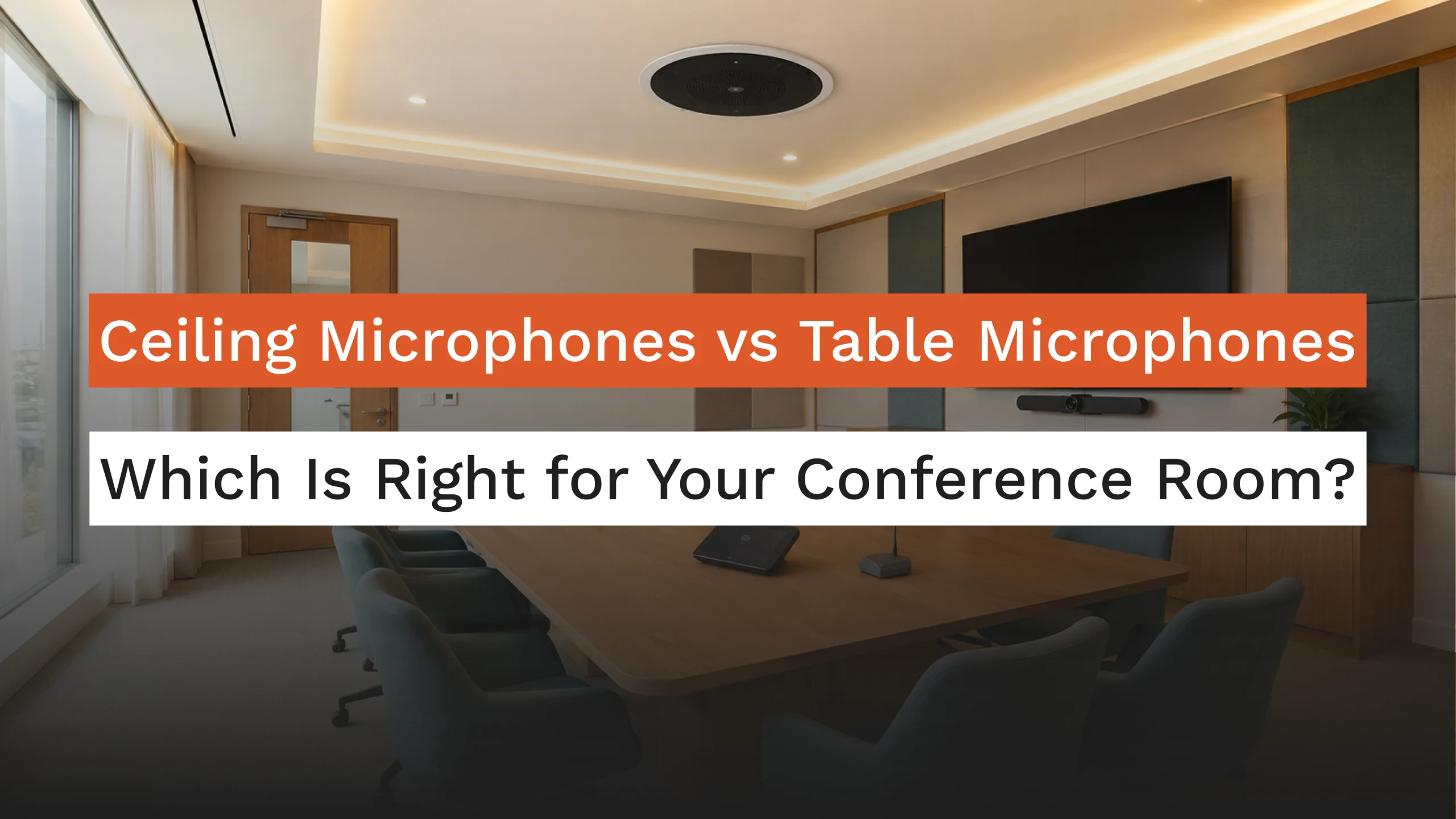
A ceiling microphone is installed above the meeting area and captures voices across the room instead of relying on microphones placed on the table. Most modern systems use beamforming technology to focus on active speakers while reducing unwanted background noise.
A ceiling microphone meeting room setup works especially well when participants move around during presentations or when seating changes from one meeting to another. Because the microphones are mounted overhead, everyone can speak comfortably without leaning toward a device.
Another advantage is appearance. Since the hardware is hidden above the ceiling, conference tables remain uncluttered and provide more space for laptops, documents, and collaboration tools.
Many businesses also choose a ceiling microphone for conference room installations because they integrate well with popular video conferencing platforms and can be expanded as meeting spaces evolve.
What are the benefits of ceiling microphones?
Ceiling microphones are designed to provide consistent audio coverage across the entire room. Instead of capturing only nearby voices, they monitor conversations throughout the meeting space.
Some of their biggest advantages include:
- Wide voice pickup across the room.
- Cleaner conference tables with no visible microphone units.
- Flexible seating arrangements.
- Better support for hybrid meetings.
- Reduced cable clutter.
- Easier integration with modern AV systems.
A professionally installed ceiling mounted conference room microphone also reduces common problems such as uneven voice levels and poor audio pickup caused by participants sitting too far from a tabletop device.
Large organizations often prefer ceiling systems because they create a cleaner meeting environment while supporting future room upgrades.
When is a ceiling microphone the better choice?
Ceiling microphones perform best in conference rooms where people collaborate naturally instead of remaining in assigned seats.
They are a strong choice for:
- Executive boardrooms.
- Hybrid meeting rooms.
- Training spaces.
- Large conference rooms.
- Flexible collaboration areas.
A ceiling microphone for large conference room installation provides consistent voice coverage even when participants are spread across a long table or seated in multiple rows. This reduces the need for several tabletop microphones and creates a more comfortable meeting experience.
Although installation usually requires professional planning, many businesses find the long-term benefits outweigh the additional setup effort.
What is a table microphone?
A table microphone sits directly on the conference table and captures voices from nearby participants. It remains one of the most common conference room audio solutions because it is easy to deploy and works well in traditional meeting spaces.
A table microphones meeting room configuration is often ideal when participants remain seated throughout the meeting and discussions take place around a fixed conference table.
Most systems connect quickly with existing conferencing equipment, making them a practical choice for businesses that want to improve audio quality without renovating their meeting rooms.
Table microphones are also available in wired and wireless versions, allowing organizations to choose the setup that best matches their room layout and budget.
What are the advantages of table microphones?
Table microphones continue to be popular because they provide reliable performance with minimal installation work.
Their main advantages include:
- Lower initial investment.
- Faster deployment.
- Easy replacement or expansion.
- Strong voice pickup for nearby speakers.
- Suitable for small and medium conference rooms.
Because the microphones are positioned close to participants, speech is often captured clearly during structured discussions where everyone remains seated.
For organizations with smaller meeting spaces, a table microphones meeting room setup can deliver excellent performance without requiring ceiling modifications or additional AV infrastructure.
Which microphone works better for hybrid meetings?
Ceiling microphones usually provide a better experience for hybrid meetings because they capture conversations from across the room without requiring participants to stay close to a microphone.
Hybrid meetings are less predictable than traditional boardroom discussions. Someone may stand to present, walk to a whiteboard, or move between seats during the session. A ceiling microphone meeting room setup handles these situations more naturally because voice pickup is spread across the meeting space.
Table microphones can still perform well during hybrid meetings, especially in smaller rooms. However, participants who sit farther away or speak while moving may not be heard as clearly.
As more businesses adopt flexible work policies, microphone systems that support natural conversation have become increasingly popular.
Which option is better for large conference rooms?
Room size is one of the biggest factors when choosing a conference room microphone system.
A ceiling microphone for large conference room installation can cover a much wider area than a single tabletop microphone. Instead of placing multiple devices across a long conference table, ceiling microphones distribute audio pickup more evenly throughout the room.
This approach offers several advantages:
- More consistent speech pickup.
- Fewer devices on the meeting table.
- Better support for presenters moving around the room.
- Cleaner room design.
- Easier expansion as meeting spaces grow.
Large boardrooms, training centres, and executive conference rooms often benefit from ceiling-mounted audio because participants are rarely seated close together.
Table microphones can still be used in larger spaces, but they typically require multiple units to achieve similar coverage.
Which microphone is easier to install?
Table microphones are generally easier and faster to install.
Most tabletop systems only require power and a connection to the conferencing platform. Businesses can often deploy them without making permanent changes to the room.
A ceiling mounted conference room microphone requires more planning. Placement, ceiling height, room acoustics, and integration with other AV equipment all affect performance.
Professional installation typically includes:
- Ceiling mounting.
- Cable routing.
- DSP configuration, when required.
- Audio calibration.
- Integration with conferencing platforms.
Although installation takes longer, ceiling microphones usually require less day-to-day interaction once configured correctly.
Which system requires less maintenance?
Both microphone systems require very little maintenance, but the type of maintenance differs.
Table microphones are easy to access if they need cleaning, replacement, or firmware updates. However, because they sit on the meeting table, they are more likely to be moved, unplugged, or damaged during everyday use.
Ceiling microphones stay out of reach, protecting them from accidental movement. Once installed, they generally require only periodic software updates and routine system checks.
Businesses planning long-term meeting room upgrades often consider this an advantage because the equipment remains fixed in its optimal position.
How does conference room design influence your decision?
Technology is only one part of a modern conference room. The overall appearance of the space also shapes how employees and visitors experience meetings.
Many organisations choose a ceiling microphone for conference room installations because they create a cleaner environment. Without microphones, cables, and connection boxes covering the table, meeting spaces appear more organised and professional.
This extra table space is especially useful in rooms where participants use laptops, notebooks, touch panels, and presentation materials during meetings.
Table microphones remain a good choice when aesthetics are less important or when conference rooms are used primarily for internal discussions.
Can you combine ceiling and table microphones?
Yes. In some conference rooms, combining both microphone types provides the best results.
For example, a large boardroom may use a ceiling microphone meeting room solution to capture general discussion while adding table microphones for presenters or executive seating positions.
This approach can improve speech clarity in rooms with unusual layouts or specialised meeting requirements.
A combined system may also be useful when conference rooms are used for board meetings, training sessions, panel discussions, and video conferences throughout the week.
The final design should always consider room acoustics, participant locations, and the conferencing platform being used rather than simply adding more microphones.
How do you choose the right conference room microphone?
The best microphone system depends on how your conference room is used today and how it may evolve in the future. Instead of focusing only on the purchase price, consider how the room supports collaboration, video conferencing, and day-to-day meetings.
Before making a decision, ask these questions:
- How many people typically use the room?
- Do participants stay seated or move around during meetings?
- Is the room used for hybrid meetings with remote attendees?
- Will the room need to support future expansion?
- How important are clean aesthetics and cable management?
- Does the microphone need to integrate with your existing AV system?
If your meetings are held in a small room with a fixed seating arrangement, table microphones may provide everything you need. They are easy to install, simple to manage, and offer good voice pickup for participants sitting nearby.
If you’re designing a new collaboration space or upgrading a larger boardroom, a ceiling microphone for conference room installation often provides greater flexibility. Participants can speak naturally from different parts of the room, and the meeting table remains free from visible equipment.
For businesses planning executive boardrooms or training spaces, a ceiling microphone for large conference room setup is usually the better long-term investment because it supports wider audio coverage and adapts more easily to changing room layouts.
How can Oxford Integration help with conference room audio?
Choosing the right microphone is only one part of creating an effective meeting space. Room acoustics, display placement, cameras, speakers, digital signal processing, and conferencing platforms all influence the overall experience.
Oxford Integration designs and delivers integrated audio visual solutions for businesses looking to improve communication across meeting rooms, boardrooms, training centres, and collaboration spaces. Every project begins with understanding how the room will be used before recommending equipment that fits those requirements.
Whether you’re building a new conference room or upgrading an existing one, selecting the right microphone system helps ensure that every participant, both in the room and joining remotely, can communicate clearly.
Final thoughts
Both ceiling microphones and table microphones have their place in modern conference rooms. The better choice depends on your room layout, meeting style, budget, and future plans.
A table microphones meeting room setup works well for organisations with smaller conference rooms, fixed seating, and straightforward installation requirements. It offers dependable performance without significant infrastructure changes.
A ceiling microphone meeting room solution is better suited to businesses that want broader voice coverage, flexible seating, and a cleaner conference table. It also provides a stronger foundation for hybrid meetings where participants may speak from different parts of the room.
Before investing in a new conference room audio system, evaluate how your teams collaborate today and how those needs may change over the next few years. Choosing the right microphone now can reduce future upgrades and create a better meeting experience for everyone.
Frequently Asked Questions
Are ceiling microphones better than table microphones?
Neither option is universally better. Ceiling microphones are ideal for medium to large conference rooms, flexible seating, and hybrid meetings. Table microphones are often the better choice for smaller rooms with fixed seating arrangements.
Do ceiling microphones work well for hybrid meetings?
Yes. Because they capture voices from across the room, ceiling microphones allow remote participants to hear conversations more naturally without requiring speakers to stay close to a microphone.
Are table microphones easier to install?
Yes. Most table microphones can be installed quickly and require fewer changes to the conference room. Ceiling-mounted systems usually involve professional installation and integration with the room’s AV infrastructure.
How many microphones does a large conference room need?
The answer depends on the room size, ceiling height, seating layout, and microphone technology. In many cases, a ceiling microphone for large conference room setup can reduce the number of microphones needed compared with multiple tabletop units.
Can ceiling microphones reduce background noise?
Many modern ceiling microphones include beamforming and noise reduction technologies that focus on active speakers while minimising unwanted sounds from the surrounding environment.
Can ceiling and table microphones be used together?
Yes. Some organisations combine both systems to improve coverage in large boardrooms or multi-purpose meeting spaces. The right configuration depends on the room design and conferencing requirements.
Which microphone is better for a new conference room?
If you’re designing a modern meeting space that supports hybrid collaboration, a ceiling mounted conference room microphone often provides better flexibility and cleaner room aesthetics. For smaller rooms with limited budgets, table microphones remain a practical solution.