
TL;DR
- Conference room echo is usually caused by hard surfaces like glass, concrete, and tile reflecting sound instead of absorbing it.
- Better microphones rarely fix echo because they capture reflected sound as well as speech.
- Improving conference room acoustics with acoustic panels, ceiling treatments, and better room design delivers clearer conversations.
- Modern UAE offices often face acoustic challenges because of glass partitions and open-plan layouts.
- Treating the room before upgrading AV equipment typically provides the biggest improvement in meeting quality.
Why does a conference room echo?
Conference room echo happens when sound waves bounce off hard surfaces instead of being absorbed. The longer those reflections remain in the room, the harder it becomes to understand conversations, especially during video meetings.
Every time someone speaks, their voice travels across the room until it hits walls, windows, ceilings, floors, and furniture. Soft materials absorb part of that energy, while hard surfaces reflect it. When enough reflections overlap, they create reverberation, making voices sound distant or repetitive.
The problem becomes more noticeable in medium and large meeting rooms because sound has more space to travel before it fades. According to the National Research Council Canada, excessive reverberation reduces speech intelligibility, making communication more difficult in enclosed spaces.
Many businesses assume their conferencing equipment is the problem. In reality, even premium microphones cannot prevent echoes created by the room itself.
Why do modern UAE offices experience more conference room echo?
Modern office design often prioritizes appearance over acoustics. Features that look clean and contemporary also happen to reflect sound extremely well.
Many offices across Dubai, Abu Dhabi, Sharjah, and other UAE cities include:
- Glass partitions
- Marble or porcelain flooring
- Exposed concrete ceilings
- Minimal furnishings
- Open layouts
While these materials create bright, professional-looking spaces, they provide very little sound absorption.
Glass is one of the biggest contributors. Unlike fabric or acoustic materials, glass reflects most speech frequencies back into the room. When several glass walls face each other, reflections multiply, producing noticeable echo during meetings.
Open-plan offices can make the situation even worse. Noise from nearby workspaces often enters meeting rooms, while reflections inside the room reduce speech clarity for everyone participating.
Can better microphones fix conference room echo?
No. Better microphones improve voice pickup, but they cannot remove echoes created by the room.
A microphone captures everything it hears. That includes direct speech, reflected voices, air-conditioning noise, keyboard clicks, and other background sounds. If the room has poor acoustics, upgrading the microphone often makes the echo more obvious rather than eliminating it.
Modern conferencing platforms such as Microsoft Teams and Zoom include software-based echo cancellation. These technologies help reduce unwanted reflections, but they work best in rooms that already have controlled acoustics.
Think of the room as the foundation of your audio system. If the room produces excessive reverberation, every microphone, speaker, and camera has to work harder to compensate.
Before replacing conferencing hardware, it is usually more effective to improve the room itself.
What affects conference room acoustics?
Conference room acoustics depend on how sound behaves inside the space. Several factors determine whether speech sounds clear or becomes difficult to understand.
Room size
Larger rooms generally produce longer reverberation because sound travels farther before losing energy.
Ceiling height
Hard materials reflect sound, while porous materials absorb it.
Common reflective surfaces include:
- Glass
- Stone
- Marble
- Concrete
- Ceramic tiles
Materials that help absorb sound include:
- Acoustic fabric panels
- Carpet
- Upholstered seating
- Heavy curtains
- Acoustic ceiling tiles
The balance between reflective and absorbent surfaces determines how comfortable the room sounds during meetings.
Surface materials
Conference room acoustics depend on how sound behaves inside the space. Several factors determine whether speech sounds clear or becomes difficult to understand.
Room size
Larger rooms generally produce longer reverberation because sound travels farther before losing energy.
Ceiling height
High ceilings increase the distance sound travels and create additional reflections unless acoustic treatments are installed overhead.
Surface materials
Hard materials reflect sound, while porous materials absorb it.
Common reflective surfaces include:
- Glass
- Stone
- Marble
- Concrete
- Ceramic tiles
Materials that help absorb sound include:
- Acoustic fabric panels
- Carpet
- Upholstered seating
- Heavy curtains
- Acoustic ceiling tiles
The balance between reflective and absorbent surfaces determines how comfortable the room sounds during meetings.
Why is speech clarity more important than eliminating all sound?
The goal of conference room acoustic design is to make conversations easy to understand.
Every meeting room needs some natural reflection. If a room absorbs too much sound, voices may feel dull or lifeless. If it absorbs too little, echo and reverberation reduce intelligibility.
Professional acoustic design aims to achieve the right balance between absorption and reflection. This allows speech to remain natural while preventing sound from lingering after someone finishes speaking.
Researchers at the Acoustical Society of America have shown that excessive reverberation makes listening more mentally demanding, particularly during long conversations and meetings.
For hybrid workplaces, this balance becomes even more important because remote participants rely entirely on the room’s audio quality.
Why has conference room acoustics become more important?
Many meetings now include participants sitting around a conference table alongside colleagues joining remotely. If the room has excessive reverberation, remote attendees often hear overlapping speech, delayed reflections, and background noise instead of clear voices.
Poor audio affects more than convenience. It slows discussions, increases repetition, and makes meetings more tiring for everyone involved.
Several studies on workplace communication have found that poor listening conditions increase cognitive effort because the brain spends more time separating useful speech from unwanted reflections.
Improving conference room acoustics helps every participant, whether they are sitting inside the room or joining from another country.
What are the first signs your meeting room has an acoustic problem?
Common signs meeting room has an acoustic problem include:
- People frequently asking others to repeat themselves.
- Remote participants complaining about echo.
- Voices sounding louder near walls than at the table.
- Meetings becoming tiring after thirty minutes.
- Speech sounding unclear even with expensive conferencing equipment.
If several of these problems occur regularly, the room likely needs acoustic treatment rather than new microphones.
How do acoustic panels reduce conference room echo?
Acoustic panels for conference room spaces reduce echo by absorbing sound energy before it reflects around the room. Instead of allowing voices to bounce between walls and ceilings, the panels convert part of that sound energy into heat, reducing reverberation and improving speech clarity.
Most office conversations occur within the mid and high frequency range. Acoustic panels are designed to absorb these frequencies, which is why they are particularly effective in meeting rooms, boardrooms, and video conferencing spaces.
Unlike decorative wall coverings, acoustic panels are engineered for sound absorption. Their effectiveness is commonly measured using the Noise Reduction Coefficient (NRC), a rating that indicates how much sound a material absorbs. Products with higher NRC ratings absorb more sound than they reflect, making them better suited for reducing echo in office environments.
Modern acoustic panels are also available in fabric, wood veneer, printed graphics, and custom colours, allowing businesses to improve sound quality without changing the overall look of the room.
Where should acoustic panels be installed?
The most effective locations to install acoustic panels include:
- Side walls where voices first reflect
- The wall behind participants
- Ceiling areas above the meeting table
- Large glass surfaces using removable acoustic solutions
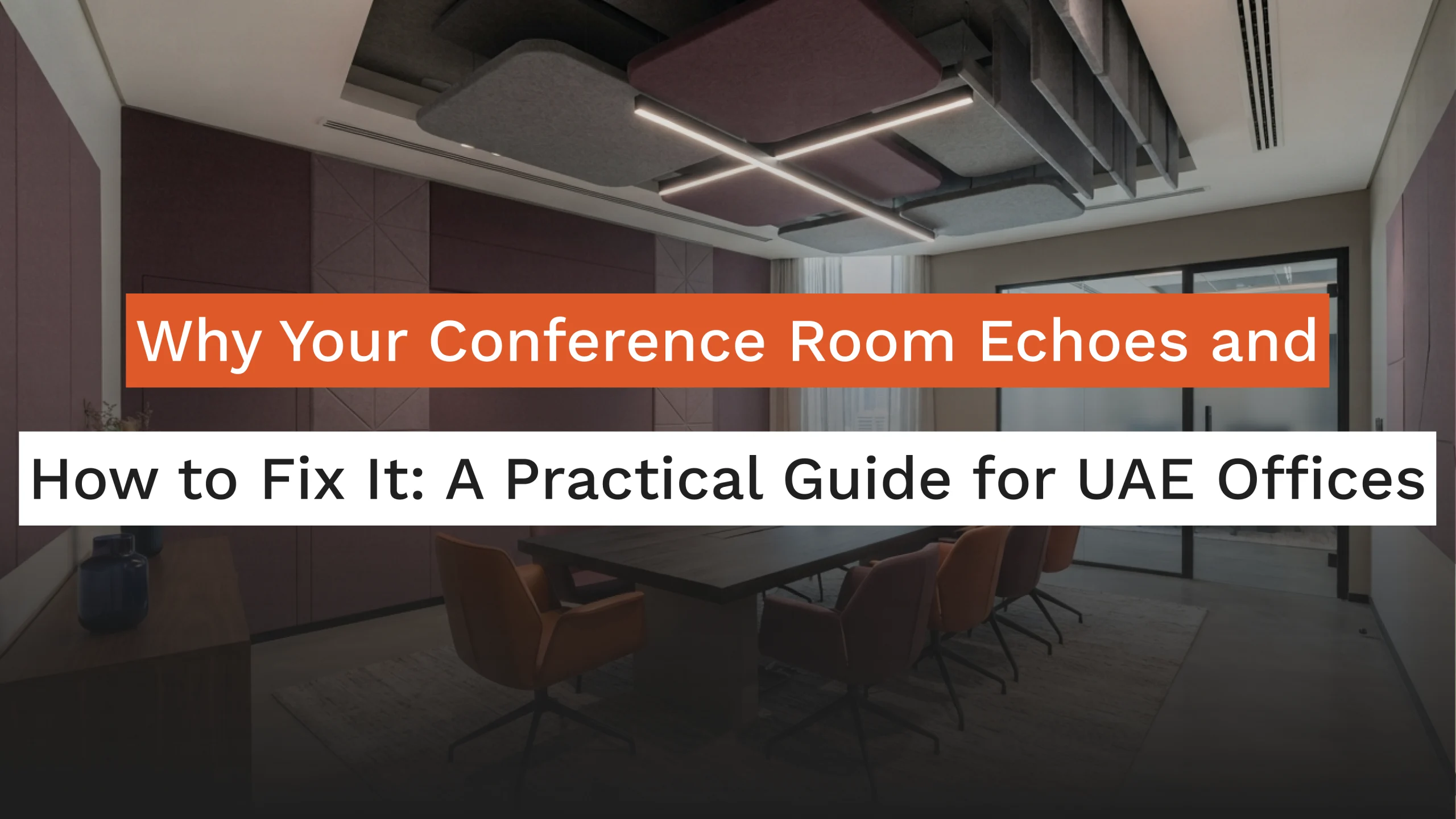
Ceilings deserve special attention because they reflect a significant amount of sound in most meeting rooms. Acoustic ceiling clouds or suspended baffles help reduce vertical reflections while maintaining an open appearance.
Glass meeting rooms often benefit from combining wall panels with ceiling treatments. This combination controls reflections from multiple directions instead of relying on a single surface.
The exact number and placement of panels depend on the room’s size, ceiling height, furniture, and wall materials. A professional acoustic assessment usually produces better long-term results than estimating panel locations by eye.
What makes a good conference room acoustic design?
Several factors influence acoustic performance, including:
- Room dimensions
- Ceiling height
- Surface materials
- Furniture layout
- Occupancy
- Type of meetings held in the room
A successful conference room acoustic design considers the room as a complete environment rather than focusing on one product.
For example, a boardroom designed for executive presentations has different acoustic requirements from a collaborative meeting room used for brainstorming sessions.
An effective design balances sound absorption with natural reflection. Too little absorption causes echo, while too much can make conversations sound flat and unnatural.
The goal is that everyoneshould hear each speaker clearly, regardless of where they are sitting.
This approach becomes even more important in hybrid meeting spaces, where microphones must capture voices for remote participants without amplifying excessive room reflections.
What is the difference between acoustic treatment and a sound proof meeting room?
Acoustic treatment improves how sound behaves inside the room. It reduces echo, controls reverberation, and improves speech clarity.
A sound proof meeting room focuses on preventing sound from travelling through the room’s boundaries. It keeps outside noise from entering and stops confidential conversations from leaking into surrounding workspaces.
The differences are straightforward.
Acoustic Treatment | Soundproofing |
Improves sound quality inside the room | Blocks sound entering or leaving the room |
Reduces echo and reverberation | Increases speech privacy |
Uses acoustic panels, ceiling absorbers, carpets, and diffusers | Uses insulated walls, acoustic doors, double glazing, and sealing systems |
Improves meeting clarity | Improves confidentiality |
Many executive boardrooms require both solutions. Employees need clear communication inside the room, while management also wants sensitive discussions to remain private.
When should you invest in a sound proof meeting room?
A professionally designed sound proof meeting room is worth considering when meetings involve:
- Financial discussions
- Legal consultations
- Human resources interviews
- Executive strategy sessions
- Healthcare consultations
- Government projects
Not every office needs complete soundproofing, but certain businesses benefit significantly from it.
In these situations, preventing conversations from being overheard is just as important as improving speech clarity.
Soundproofing usually involves structural improvements such as insulated partition walls, acoustic doors, laminated glazing, perimeter seals, and isolated ceiling systems. These measures reduce sound transmission between rooms while supporting better communication inside the meeting space.
Why don't soft furnishings solve the entire problem?
Adding carpets, curtains, or upholstered chairs can reduce some sound reflections, but they rarely eliminate conference room echo on their own.
Soft furnishings absorb only a portion of reflected sound, and their effect depends on how much of the room they cover. A single rug beneath the meeting table, for example, has little impact if the surrounding walls and ceiling remain highly reflective.
Acoustic panels and ceiling treatments are designed to absorb far more sound than standard office furniture. When combined with soft furnishings, they create a balanced acoustic environment where conversations remain clear without making the room feel overly quiet.
For larger meeting spaces, relying solely on furniture is unlikely to deliver consistent results.
What mistakes make the conference room echo worse?
Many acoustic problems begin during office design rather than after employees move in.
One common mistake is prioritising visual aesthetics without considering how sound behaves. Large glass walls, polished stone flooring, and exposed ceilings create multiple reflective surfaces that allow sound to bounce throughout the room.
Another mistake is assuming more technology will solve the issue. Installing additional speakers or premium microphones often amplifies existing reflections instead of removing them.
Businesses also sometimes install too few acoustic panels or place them only on one wall. Effective acoustic treatment requires sufficient coverage across the room’s primary reflection points.
Ignoring the ceiling is another frequent oversight. Because ceilings reflect a large amount of speech, treating only the walls often leaves noticeable reverberation.
Addressing these issues during the planning stage is usually more cost-effective than making corrections after construction is complete.
How do you choose the right acoustic solution for your office?
The best solution depends on your meeting room’s size, layout, finishes, and how the space is used. A small meeting room with drywall and carpet needs a different approach than a large boardroom surrounded by glass.
Before purchasing any products, evaluate:
- Room dimensions
- Ceiling height
- Wall and floor materials
- Number of regular occupants
- Frequency of video conferencing
- Privacy requirements
For example, a meeting room used mainly for internal discussions may only require wall-mounted acoustic panels. An executive boardroom hosting client presentations and confidential meetings may benefit from ceiling treatments, acoustic wall panels, and additional soundproofing measures.
A professional acoustic assessment can identify the main reflection points and recommend treatments based on measured performance rather than guesswork.
Should you improve acoustics before upgrading AV equipment?
In most cases, yes. Treating the room first often improves the performance of existing conferencing equipment. Once echoes are reduced, microphones can focus on direct speech instead of competing with unwanted reflections.
Many organisations replace microphones, speakers, or cameras because meeting audio sounds poor. If the room itself creates excessive reverberation, the new equipment will still capture reflected sound.
If you’re planning an office upgrade, consider acoustics and audiovisual technology as parts of the same project rather than separate investments. This approach usually delivers better meeting quality and avoids unnecessary hardware upgrades.
What are the business benefits of better conference room acoustics?
Improving conference room acoustics affects more than sound quality. It helps meetings run more efficiently and creates a better experience for employees, clients, and remote participants.
Some of the most noticeable benefits include:
Clearer communication
When speech is easy to understand, conversations move faster and participants spend less time asking people to repeat themselves.
Better hybrid meetings
Video conferencing platforms perform more effectively when microphones capture clear speech instead of excessive room reflections. Remote attendees can follow discussions without struggling to separate voices from background echo.
Reduced listening fatigue
Poor acoustics force the brain to work harder to understand speech. Reducing reverberation lowers listening effort during long meetings, making it easier for participants to stay focused.
A more professional meeting environment
Clients often judge a meeting room within the first few minutes of a presentation. Clear audio creates a stronger impression than a room where conversations are interrupted by echo or poor intelligibility.
Improved return on technology investments
Conference cameras, ceiling microphones, and speaker systems perform closer to their intended capabilities when installed in acoustically balanced rooms.
What should businesses consider during office fit-outs?
Acoustic planning is easier and often less expensive during the design stage than after construction has finished.
If you’re planning a new office or renovating an existing workspace, discuss acoustics before finalising architectural drawings. This allows designers to include sound-absorbing materials without compromising the room’s appearance.
Key considerations include:
- Reducing large uninterrupted glass surfaces where possible
- Selecting ceiling systems with acoustic performance in mind
- Including soft finishes where appropriate
- Planning wall space for acoustic treatments
- Positioning conferencing equipment after the room’s acoustics have been addressed
These decisions help avoid expensive retrofits later and produce meeting spaces that perform well from the first day of use.
Why are acoustic solutions becoming more common in UAE offices?
Office design trends across the UAE increasingly favour open layouts, glass partitions, and collaborative workspaces. While these designs support natural light and modern aesthetics, they also create environments where sound travels more freely.
At the same time, hybrid work has become a permanent part of many organisations. Meeting rooms are now expected to support in-person discussions, client presentations, and video conferences with participants joining from multiple locations.
As a result, businesses are paying closer attention to acoustic performance during office fit-outs and refurbishments. Rather than relying solely on conferencing technology, they are recognising that room acoustics play a major role in meeting quality.
Conclusion
Conference room echo is rarely caused by conferencing equipment. In most cases, it results from reflective surfaces that allow sound to continue bouncing around the room after someone has finished speaking.
Improving conference room acoustics starts with understanding how sound behaves within the space. Acoustic panels, ceiling treatments, and thoughtful conference room acoustic design reduce reverberation and improve speech clarity without changing the room’s overall appearance.
For businesses that also require privacy, a professionally designed sound proof meeting room can prevent external noise from entering while keeping confidential conversations inside.
As hybrid work continues to shape modern workplaces across the UAE, investing in acoustics is no longer just a design decision. It is a practical way to improve communication, support collaboration, and help existing AV technology perform at its best.
If you’re planning a new office, renovating a boardroom, or struggling with poor meeting audio, start by assessing the room itself. In many cases, treating the space delivers a bigger improvement than replacing microphones or speakers.
Frequently Asked Questions
What causes conference room echo?
Conference room echo occurs when sound reflects off hard surfaces such as glass, concrete, marble, or tiled floors. These reflections remain in the room long enough to overlap with new speech, reducing clarity during conversations and video calls.
How can conference room acoustics be improved?
The most effective approach combines acoustic wall panels, ceiling absorbers, suitable flooring, upholstered furniture, and thoughtful room layout. Together, these treatments reduce reverberation and improve speech intelligibility.
Are acoustic panels effective in meeting rooms?
Yes. Acoustic panels for conference room applications are designed to absorb sound reflections that cause echo. Properly positioned panels improve speech clarity for both in-person and remote meeting participants.
What is the difference between acoustic treatment and soundproofing?
Acoustic treatment improves sound quality inside the room by controlling reflections. A sound proof meeting room reduces sound transmission through walls, doors, ceilings, and glazing to improve privacy and minimise external noise.
Should acoustics be improved before upgrading conferencing equipment?
In many situations, yes. Addressing room acoustics first allows microphones and speakers to perform more effectively because they capture clearer speech with fewer reflections.