
TL;DR
- Choosing the right zoom rooms hardware depends on your room size, meeting style, and budget.
- A complete zoom room setup includes a controller, camera, microphone, speakers, display, and compute device.
- Different meeting rooms need different zoom room equipment, from simple all-in-one bars to modular AV systems.
- UAE businesses should consider room acoustics, display size, and future expansion before buying hardware.
- Certified zoom room devices help ensure reliable performance and easier management.
Selecting the right zoom rooms hardware is one of the most important decisions when building a professional meeting space. Good hardware improves audio quality, video clarity, and meeting reliability. Poor hardware often leads to missed conversations, delayed meetings, and frustrated participants.
Whether you’re planning a small huddle room in Dubai, a boardroom in Abu Dhabi, or multiple conference spaces across the UAE, understanding your hardware options helps you spend your budget wisely. This guide explains every major component, how to choose the right equipment, and what works best for different office environments.
What Is Zoom Rooms Hardware?
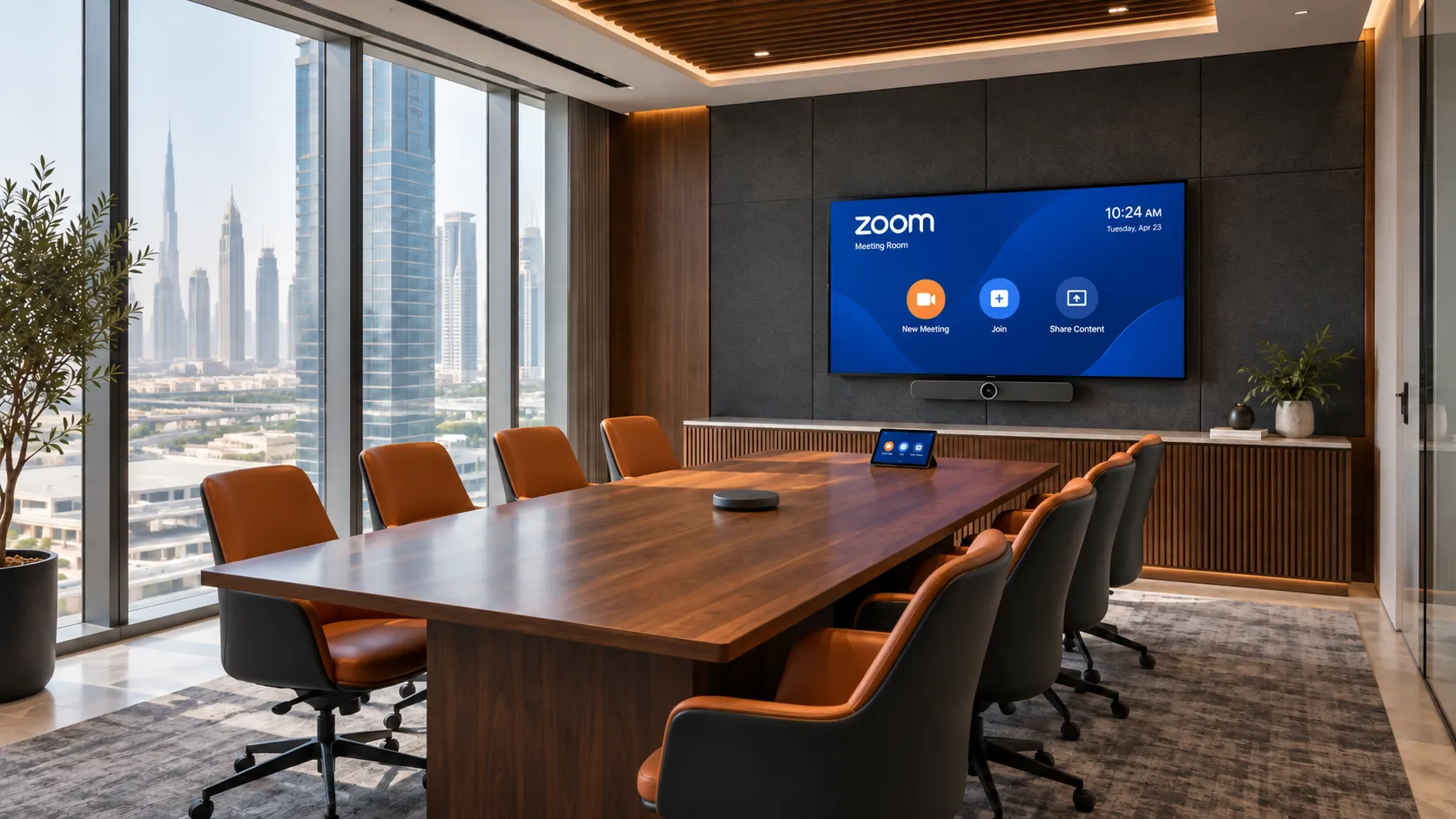
Zoom Rooms hardware refers to the physical equipment that turns a meeting room into a dedicated Zoom video conferencing space. Instead of relying on employees’ laptops, the room has its own meeting system that anyone can use with a single tap.
A standard zoom room system usually includes:
- Meeting room display or dual displays
- Conference camera
- Microphones
- Speakers
- Zoom controller or touch panel
- Mini PC or dedicated compute device
- Network connection
These components work together through Zoom Rooms software to provide a consistent meeting experience.
According to Zoom’s hardware certification program, certified devices are tested for compatibility, performance, and reliability before being approved for Zoom Rooms.
Why Do UAE Offices Invest in Dedicated Zoom Rooms?
Dedicated meeting rooms save time, improve collaboration, and create a more professional experience for both employees and clients.
Many UAE businesses now operate with hybrid teams. Some employees work from the office, while others join remotely from different emirates or countries. A properly designed zoom room setup ensures everyone can see and hear each other clearly.
What Hardware Does a Complete Zoom Room Need?
A complete zoom room setup includes several components that work together. Skipping one element often affects the entire meeting experience.
Display Screens
The display is where participants view remote attendees and shared content.
Small meeting rooms often use a single display. Larger conference rooms usually benefit from dual displays. One screen shows participants while the other displays presentations or documents.
Zoom recommends display sizes based on viewing distance to help everyone comfortably read shared content.
Conference Camera
The camera is one of the most visible parts of any zoom room equipment package. Different rooms require different camera types.
Fixed Cameras
These are suitable for:
- Small meeting rooms
- Huddle spaces
- Private offices
They offer a wide viewing angle and minimal maintenance.
PTZ Cameras
Pan, Tilt, and Zoom cameras are designed for:
- Large conference rooms
- Boardrooms
- Training rooms
These cameras can automatically frame participants or focus on the active speaker.
Some modern zoom room devices even support AI-powered speaker tracking, making conversations feel more natural for remote attendees.
The Zoom Certified Hardware Directory lists cameras tested specifically for Zoom Rooms compatibility.
Microphones
Clear audio is more important than high video resolution.
People will often tolerate average video, but poor audio quickly makes meetings difficult.
Common microphone options include:
Table Microphones
Suitable for:
- Small conference rooms
- Executive meeting rooms
- Boardroom tables
They are easy to install but may require multiple units in larger spaces.
Ceiling Microphones
Better suited for:
- Medium rooms
- Large meeting rooms
- Flexible furniture layouts
Ceiling microphones capture voices across the room without taking up table space.
Speakers
Every participant should hear remote voices at a comfortable volume without echoes.
Many modern zoom room equipment solutions combine microphones and speakers into one audio bar for smaller rooms.
Larger rooms often use:
- DSP processors
- Ceiling speakers
- Wall-mounted speakers
- Professional amplifiers
This approach provides more even sound coverage throughout the room.
Zoom Room Controller
The controller is the touch panel used to start and manage meetings.
Instead of opening Zoom on a laptop, users simply tap:
- Join Meeting
- Start Meeting
- Share Content
- Camera Controls
- Participant Management
This simplicity is one reason many organizations prefer a dedicated zoom room system over laptop-based meeting setups.
Compute Device
Behind every Zoom Room is a computer that runs the Zoom Rooms application.
Common options include:
- Windows Mini PCs
- Android-based appliances
- Dedicated conferencing computers
The choice depends on the selected hardware ecosystem and room requirements.
How Do You Choose the Right Zoom Rooms Hardware for Different Room Sizes?
The correct zoom rooms hardware depends less on office size and more on the number of people using the room at the same time. A six-person huddle space has very different needs from a twenty-seat boardroom, even if both are used for daily video meetings.
How Much Zoom Rooms Hardware Does Each Room Size Need?
The right amount of zoom rooms hardware depends on how many people will regularly use the room. Buying more equipment than necessary increases costs, while buying too little leads to poor audio, limited camera coverage, and frustrating meetings.
Here’s a practical guide for common office spaces in the UAE.
| Room Size | Capacity | Recommended Camera | Audio Solution | Displays | Best Zoom Room Setup |
|---|---|---|---|---|---|
| Huddle Room Small Meeting Room | 2 to 4 people 4 to 8 people | All-in-one video bar Wide-angle camera | Built-in microphone and speaker Speakerphone or video bar | 1 1 | Simple appliance-based setup Single display with touch controller |
| Medium Conference Room | 8 to 12 people | PTZ or intelligent camera | Expansion microphones or ceiling microphones | 2 | Modular Zoom Room system |
| Large Boardroom | 12 to 20+ people | Multiple PTZ cameras | DSP, ceiling microphones, ceiling speakers | 2 | Professional AV integration with dedicated compute device |
A room should always be designed around how people collaborate, not just its physical dimensions. For example, a narrow boardroom with 10 participants may require a different camera placement than a square room with the same seating capacity.
Should You Choose an All-in-One Video Bar or Modular Equipment?
For most small offices, an all-in-one video bar is the easiest option. Larger meeting rooms benefit from modular systems because they offer greater flexibility and better coverage.
Understanding the difference helps you avoid paying for features you may never use.
All-in-One Video Bars
These combine several components into one device:
- Camera
- Microphones
- Speakers
- AI framing features
- Noise reduction
Advantages include:
- Faster installation
- Fewer cables
- Lower installation costs
- Easier management
- Cleaner appearance
These are commonly used for:
- Executive offices
- Huddle rooms
- Small meeting rooms
- Startup offices
Many certified zoom room devices now include intelligent framing, automatic speaker tracking, and background noise suppression.
Modular Zoom Room Systems
A modular zoom room system separates every major component.
Instead of one device, the room includes:
- Dedicated PTZ camera
- Ceiling microphones
- Ceiling speakers
- DSP processor
- Professional controller
- Compute device
Advantages include:
- Better audio coverage
- Easier upgrades
- More camera options
- Improved performance in larger rooms
- Support for custom room layouts
This approach is common in:
- Government meeting rooms
- Corporate boardrooms
- Universities
- Training centers
- Auditoriums
Which Zoom Room Equipment Is Essential and Which Is Optional?
Some zoom room equipment is required for every installation. Other devices depend on the room’s size and meeting requirements.
Essential Equipment
Every room should include:
- Certified camera
- Display
- Microphone
- Speaker
- Touch controller
- Compute device
- Stable wired network connection
Without these components, the room cannot function as a dedicated Zoom Room.
Optional Equipment
Many UAE offices also add:
- Wireless presentation systems
- Digital whiteboards
- Room scheduling panels
- Secondary displays
- USB expansion hubs
- Additional ceiling microphones
- PTZ camera presets
- Occupancy sensors
These upgrades improve usability but are not mandatory for every meeting space.
What Features Should You Look for When Buying Zoom Room Devices?
Not every certified device offers the same capabilities. The best zoom room devices include features that improve both user experience and long-term reliability.
AI Camera Framing
AI framing automatically adjusts the camera view so participants remain centered during meetings.Instead of manually moving the camera, the system follows people as they enter or leave the room.
Zoom explains how intelligent director and smart framing improve remote meeting visibility.
Speaker Tracking
Speaker tracking detects who is talking and focuses the camera on that person.This creates a more natural experience for remote participants, especially during discussions.
Noise Suppression
Office environments are rarely silent. Good zoom rooms hardware should reduce distractions such as:
- Air conditioning
- Keyboard typing
- Paper shuffling
- Door closing
- Background conversations
Zoom’s built-in audio processing works best when paired with certified hardware.
Remote Device Management
IT teams managing multiple meeting rooms should choose hardware that supports centralized monitoring.
This allows administrators to:
- Check device health
- Install firmware updates
- Restart systems remotely
- Monitor room status
For organizations with offices across Dubai, Abu Dhabi, Sharjah, and other Emirates, remote management can significantly reduce maintenance time.
Dual Display Support
One display is enough for many small meeting rooms. However, larger conference rooms often benefit from two screens.
A common setup is:
- Display 1: Remote participants
- Display 2: Shared presentations
This helps attendees keep track of both the discussion and the content being presented.
What Network Requirements Does a Zoom Room Setup Need?
Even the best zoom room setup performs poorly without a reliable network. Stable internet and proper network planning are just as important as cameras and microphones.
Zoom recommends using wired Ethernet wherever possible because it offers lower latency and greater stability than Wi-Fi.
A well-designed meeting room network should include:
- Gigabit Ethernet connection
- Business-grade firewall
- Quality of Service (QoS) settings
- Reliable internet bandwidth
- Secure network segmentation for AV devices
According to Zoom‘s network recommendations, bandwidth needs vary depending on video quality, participant count, and screen sharing activity.
Can Existing Meeting Room Equipment Be Reused?
Yes, in many cases. Existing displays, speakers, or cameras may be compatible with a new zoom room system, provided they meet Zoom’s requirements and support the necessary connections.
For example:
An office that already has:
- A commercial display
- Ceiling speakers
- A DSP
- HDMI cabling
May only need to add:
- A certified compute device
- A Zoom Room controller
- Compatible camera
- Certified microphones
Reusing compatible AV equipment can lower upgrade costs, especially when renovating conference rooms instead of building new ones.
However, compatibility should always be verified using Zoom’s Certified Hardware directory before purchasing additional components.
What Mistakes Should You Avoid When Buying Zoom Rooms Hardware?
Most meeting room problems are caused by poor planning rather than faulty equipment. Choosing the wrong zoom rooms hardware can result in unclear audio, limited camera coverage, and expensive upgrades later.
Here are the mistakes seen most often during office deployments.
Buying Hardware Based Only on Price
Lower-cost equipment can be suitable for small rooms, but it is not always the right choice for larger spaces.
For example, an all-in-one video bar may work well in a four-person meeting room. The same device will struggle to capture voices clearly in a boardroom with 16 attendees.
Instead of focusing only on cost, consider:
- Room dimensions
- Seating layout
- Daily meeting frequency
- Number of remote participants
- Future expansion
The goal is to match the hardware to the room, not simply buy the cheapest package.
Ignoring Audio Coverage
People often pay attention to camera quality first, but audio has a greater impact on meeting quality. A 4K camera cannot compensate for participants who sound distant or unclear.
During planning, ask questions such as:
- Can everyone be heard from every seat?
- Will HVAC noise affect microphones?
- Is echo likely because of glass walls?
- Are expansion microphones required?
Good audio design should always come before selecting the camera.
Installing Displays That Are Too Small
Small displays make presentations difficult to read.
Employees sitting at the back of the room may struggle to view spreadsheets, drawings, or dashboards.
Display size should be chosen based on viewing distance, not simply available wall space.
Commercial displays are generally a better choice than consumer televisions because they are designed for longer operating hours.
Forgetting About Room Acoustics
Even premium zoom room equipment performs poorly in rooms with excessive echo.
Hard surfaces such as glass, polished concrete, and large meeting tables reflect sound throughout the room.
Simple improvements can make a noticeable difference:
- Acoustic wall panels
- Carpet tiles
- Fabric furniture
- Acoustic ceiling treatments
- Curtains where appropriate
The goal is not to eliminate every reflection, but to create a room where voices remain clear.
Choosing Non-Certified Devices
Certified zoom room devices are tested to work with Zoom Rooms software.
Using unsupported hardware may create issues such as:
- Driver conflicts
- Missing features
- Firmware compatibility problems
- Longer troubleshooting times
Zoom regularly updates its certified hardware list, making it easier to verify compatibility before purchasing.
Which Zoom Rooms Hardware Works Best for Different UAE Offices?
Every workplace has different meeting habits. The best zoom rooms hardware for one business may not suit another.
Here are a few practical examples.
Small Businesses and Startups
A startup with one meeting room usually benefits from a simple zoom room setup.
A typical configuration includes:
- One display
- All-in-one video bar
- Touch controller
- Appliance-based compute device
This setup is easy to maintain and supports everyday team meetings and client calls.
Corporate Offices
Large companies often require multiple meeting spaces of different sizes.
For example:
- Huddle rooms for quick discussions
- Medium conference rooms for team meetings
- Executive boardrooms for client presentations
Standardizing hardware across rooms also makes training and support easier for IT teams.
Government Offices
Government organizations often require:
- Better microphone coverage
- Larger displays
- Multiple PTZ cameras
- Centralized device management
These environments usually benefit from a modular zoom room system that can be expanded over time.
Education and Training Centers
Universities and corporate training facilities frequently need:
- Instructor tracking
- Dual displays
- Wireless presentation
- High-quality ceiling microphones
These features help both in-room and remote participants follow lessons more effectively.
Healthcare Organizations
Hospitals and healthcare providers use video meetings for administration, staff collaboration, and virtual consultations.
Meeting rooms in these environments often prioritize:
- Clear speech pickup
- Reliable network connectivity
- Easy-to-clean hardware
- Secure meeting controls
How Should You Plan Your Zoom Room Budget?
The best budget is one based on room requirements rather than a fixed amount per meeting space.
Start by dividing costs into three categories.
Hardware
This includes:
- Cameras
- Displays
- Microphones
- Speakers
- Controllers
- Compute devices
Installation
Installation costs may include:
- Mounting displays
- Cable routing
- Network configuration
- Equipment testing
- User training
Professional installation is especially valuable for larger conference rooms where audio tuning and camera positioning affect meeting quality.
Future Expansion
Meeting rooms rarely stay the same for years. When planning a zoom room setup, leave room in the budget for:
- Additional microphones
- Camera upgrades
- Display expansion
- Software licensing
- Hardware replacement after several years
Planning for growth often costs less than redesigning the room later.
How Can You Future-Proof Your Zoom Room System?
Meeting technology continues to evolve. Choosing flexible hardware today can reduce replacement costs in the future.
Consider these points when selecting a zoom room system.
Choose Certified Hardware
Certified devices receive compatibility testing and ongoing support from manufacturers and Zoom.
This improves long-term reliability and simplifies software updates.
Use Modular Designs for Larger Rooms
Modular rooms make future upgrades much easier.
For example, you can replace:
- Camera only
- Microphones only
- Compute device only
instead of replacing the entire system.
Think Beyond Today's Team Size
A meeting room built for six people may regularly host ten participants within a year.
Planning for moderate growth can prevent costly redesigns.
Select Displays with Expansion in Mind
Many organizations begin with one display and later move to dual-screen collaboration.
Choosing compatible equipment from the beginning makes that transition much simpler.
Keep Firmware Updated
Manufacturers regularly release firmware updates that improve:
- Security
- Performance
- Compatibility
- AI features
Keeping devices updated helps maintain a consistent meeting experience.
Practical Example: Choosing the Right Hardware
Imagine a Dubai-based engineering company opening a new office with three meeting spaces.
Room 1: Four-person huddle room
- Single 65-inch display
- All-in-one video bar
- Touch controller
- Appliance-based system
Room 2: Ten-person conference room
- Dual displays
- PTZ camera
- Expansion microphones
- Dedicated compute device
- Touch controller
Room 3: Executive boardroom
- Dual commercial displays
- Multiple PTZ cameras
- Ceiling microphones
- Ceiling speakers
- DSP processor
- Centralized device management
Instead of buying identical equipment for every room, the company matches the hardware to each room’s purpose. This improves meeting quality while avoiding unnecessary spending.
Final Thoughts
Choosing the right zoom rooms hardware starts with understanding how each meeting room is actually used. A small meeting space does not need the same equipment as a boardroom, and buying more hardware than necessary rarely improves the meeting experience.
A complete zoom room setup combines the right camera, microphones, speakers, display, controller, and compute device into a system that fits the room size and daily workflow. When these components are planned together, meetings become easier to start, conversations are clearer, and remote participants stay engaged.
Certified zoom room equipment also reduces compatibility issues and makes future software updates easier. If your office expects to grow, selecting scalable zoom room devices today can help avoid costly upgrades later.
For UAE businesses, the best approach is to assess each meeting space individually rather than applying the same hardware package to every room. A well-planned zoom room system delivers reliable performance, supports hybrid collaboration, and remains useful as your workplace evolves.
Frequently Asked Questions
What is included in Zoom Rooms hardware?
A standard zoom rooms hardware package includes a display, conference camera, microphones, speakers, a touch controller, and a compute device running Zoom Rooms software. Larger meeting spaces may also include ceiling microphones, DSP processors, multiple cameras, and dual displays.
Can I use my existing meeting room equipment with Zoom Rooms?
Yes, in many cases. Existing displays, speakers, or AV infrastructure can often be reused if they are compatible with Zoom Rooms. Before purchasing new equipment, check the Zoom Certified Hardware Directory to confirm compatibility.
What is the difference between Zoom Rooms hardware and a regular Zoom meeting?
A regular Zoom meeting relies on a user’s laptop, webcam, and microphone. A dedicated zoom room system uses permanently installed hardware designed for meeting rooms, allowing anyone to start scheduled meetings with a single touch.
Which Zoom Room devices are best for small offices?
Small offices usually benefit from certified all-in-one zoom room devices that combine the camera, microphones, and speakers into a single unit. These systems are easier to install, require less maintenance, and work well for rooms with four to eight participants.
How do I choose the right Zoom room setup for my office?
Start by considering room size, seating capacity, meeting frequency, and whether participants will join remotely. A small huddle room may only require a video bar and display, while a large boardroom will usually need PTZ cameras, ceiling microphones, ceiling speakers, and a dedicated compute device for the best meeting experience.