
The conference room has become a pressure test.
Every dropped call, every “can you hear me now?” from a remote participant, every five-minute cable hunt before a client presentation. They cost businesses money and credibility.
And that’s why investment in smart meeting room solutions in Dubai is accelerating fast, and the numbers back it up.
- The global Pro AV market is projected to grow from $332 billion in 2025 to $402 billion by 2030, with conferencing and collaboration among the top-performing solution areas.
- Closer to home, 98% of UAE businesses signaled active investment in hybrid workplace technology by 2024. Source Qureos.
- The smart conference room market alone was estimated at $8 billion in 2025, growing at roughly 15% compounded annually through 2033.
Businesses in Dubai are spending because the old setup stopped working.
Outdated conference room technologies cost time, damage client trust, and make hybrid work harder than it needs to be.
The companies moving fastest are the ones that stopped treating the meeting room as furniture.
The Growing Demand for Smart Collaboration Spaces
So here is what changed:
The meeting room used to serve one type of user. Everyone sat at the same table. The projector either worked or it didn’t, and someone would restart it.
Hybrid work changed everything permanently. Now every conference room has to serve two audiences simultaneously.
- The people in the room
- The remote participants
Getting that balance right requires room technologies that were not designed for the old setup.
Modern meeting spaces in Dubai are built for two types of audiences.
That means high-quality ceiling microphone arrays that pick up voices from every corner of a large conference room, not just whoever is sitting next to the speakerphone.
It means conference camera systems with AI-powered auto-framing that follow speakers as they move, so remote participants see a person, not a wide shot of an empty chair and ceiling tiles.
It also means conference room display systems that are bright enough to be read from 15 feet away without someone squinting.
Wireless Connectivity & Room Scheduling Are Now Baseline Expectations
Wireless connectivity is table stakes now, not a premium feature. Employees expect to walk into any meeting space, connect their device in seconds, and start presenting. Just like that!
Dubai the movement is fast, that means, the cables, the adapters, the “does this room have HDMI or DisplayPort?” conversation, that’s a friction businesses can no longer afford.
Room scheduling technology has also shifted from nice-to-have to essential. Smart room display panels outside each conference room give staff real-time visibility into room availability without hunting down calendar invites.
The awkward standoff at the door? That’s gone too. Meeting room booking systems sync with Microsoft Teams, Zoom, and Google Meet calendars eliminate double-booking.
Why Dubai Businesses Have a Higher Bar?
Poor video meeting quality doesn’t just embarrass the local team. It signals to the other side of the table that operational quality may be equally unreliable.
How Advanced Meeting Technologies Improve Productivity?
The link between meeting room technology and productivity is measurable. When the technology disappears into the background, the meeting gets better. People stop problem-solving the room and start problem-solving the actual agenda.
Wireless conferencing solutions remove the single biggest time thief in most corporate meeting spaces: the setup ritual, display drivers, input source switching every minute spent on that is a minute not spent on the work.
Modern wireless presentation systems let any participant, on any device, share their screen in under 20 seconds.
Across a hundred meetings a week in a mid-size office, it reclaims working hours.
What AI Does in a Conference Room Today?
AI now plays an inseparable role in meeting productivity too.
AI-powered noise cancellation in platforms like Zoom and Microsoft Teams filters out HVAC hum, keyboard noise, and ambient office sounds before the audio reaches remote participants.
The difference is obvious. Zoom AI Companion provides automated meeting summaries and action item extraction included with paid Zoom plans. Microsoft Copilot for Teams delivers similar intelligent recap capabilities through its add-on subscription. These tools mean that someone who had to leave a meeting early doesn’t miss decisions. Someone joining from a noisy coffee shop doesn’t derail the call.
Display Quality and Decision-Making Speed
Conference room display systems directly improve decision-making speed. Ultra-high-definition 4K screens, interactive displays with real-time annotation, and dual-display setups keep both the presentation and the participant gallery visible at the same time
They reduce the friction of sharing and understanding information, which is the whole point of a meeting.
For teams that brainstorm or plan visually, digital whiteboards have replaced the markers-on-glass experience.
Tools like the Microsoft Surface Hub and software-based whiteboard platforms that integrate with Teams Rooms and Zoom Rooms let distributed teams collaborate on the same canvas in real time, whether one participant is across the table or across a time zone.
The Role of AV Integration in Modern Meeting Spaces
Buying the right devices is easy. Getting them to work together is where most installs fail.
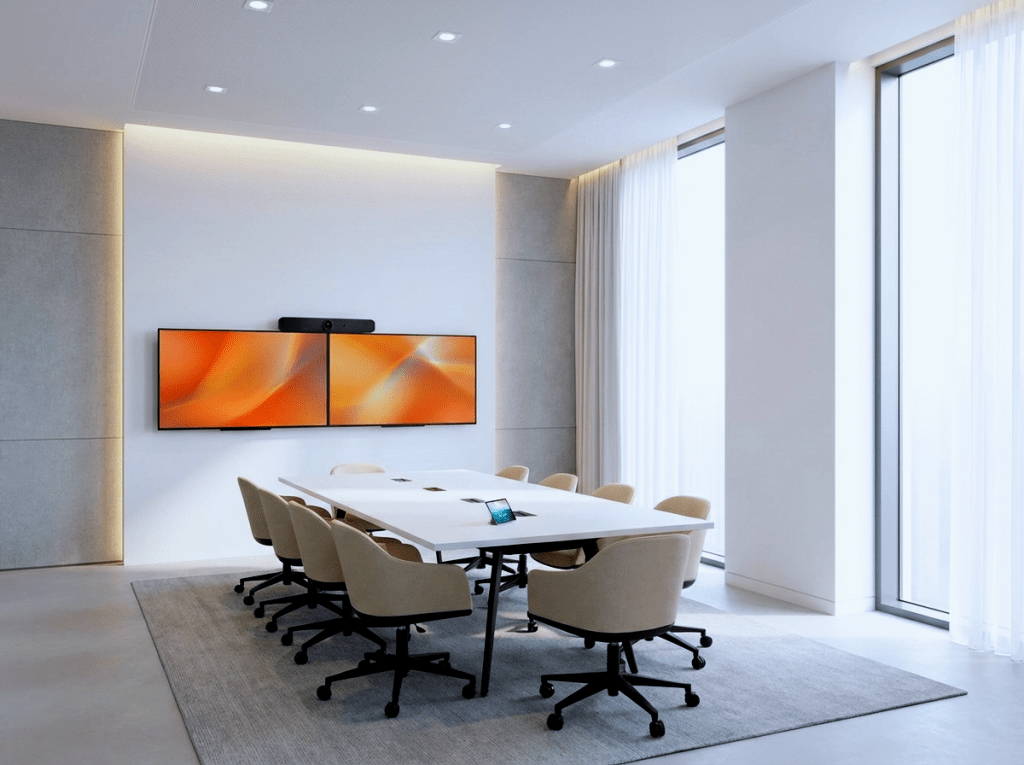
A Logitech Rally Bar, Shure beamforming microphone, dual 4K displays, and a Zoom Rooms or Microsoft Teams Rooms unit will underperform if set up wrong.
Network bandwidth, audio DSP, display routing, and room control all have to work as one system.
The Rally Bar handles RightSight 2 auto-framing, grid view, and runs Teams Rooms, Zoom Rooms, and Google Meet from a single unit. Worth a closer look:
Why Different Room Types Need Different Specifications?
A room display outside the door needs live calendar data, accurate availability, and on-the-spot booking. Without proper integration with the identity management system and meeting platform, it just adds more confusion.
Different rooms have different needs.
Huddle rooms for three to four people need a compact video bar, wireless connectivity, and minimal setup. The design is completely different from a 20-person boardroom, which needs distributed microphone coverage, multiple display zones, and a camera that switches between wide group shots and individual speakers.
Oxford Integration designs, installs, and commissions conference room systems across the UAE around how each space is actually used. Cabling, rack design, software configuration, staff training. The end result is a room anyone walks into and uses without thinking about it.
Ready to Upgrade Your Meeting Rooms?
Hybrid Work Culture Is Driving Technology Investments
The data from across the GCC is consistent: the workforce expects flexibility, and businesses that create friction around hybrid participation will lose talent to organizations that don’t.
The challenge is that most conference room technologies were designed around in-person attendance. A standard conference room with a single camera pointing at a whiteboard and a speakerphone in the middle of the table was adequate when everyone was physically present.
In a hybrid meeting, remote participants are reduced to watching the backs of heads and straining to hear someone across the room from the microphone.
When remote participants have the same audio clarity, the same view of the presenter, and the same ability to share content and contribute as in-room attendees, meetings produce better outcomes. When they don’t, remote workers disengage or opt out.
What modern hybrid meeting rooms actually require is layered.
What Does a Hybrid Meeting Room Need?
First, intelligent audio.
Second, intelligent video.
Third, wireless connectivity.
Fourth, unified platform compatibility.
Winning Client Experience Through Smart Meeting Rooms
The first few minutes of a client meeting communicate something before anyone says a word.
Dubai’s corporate sector is particularly conscious of this. In a market where financial services firms, government entities, law practices, and multinational headquarters operate from the same DIFC and Downtown addresses, the quality of the meeting environment is part of the brand.
Companies that invest in modern conference room setups consistently report stronger first impressions with international partners.
A 4K boardroom display calibrated for the room’s lighting looks different from a TV pulled out of a box. Clients notice.
Annotate on screen, zoom into a detail mid-pitch, rearrange content without breaking flow. Presenters stay in control.
Good audio matters more than most people admit. Noise suppression and a stable connection mean the conversation stays on the topic, not the tech.
Digital whiteboards mean the client leaves with the actual file, not your promise to send something later.
Security and Reliability in Modern Conference Rooms
Two things tend to get underweighted in conference room technology conversations:
- Security
- Reliability
On security
Board reviews, legal calls, and commercial negotiations happen in meeting rooms. Wireless sharing and cloud conferencing have made those rooms a real exposure point.
Businesses in Dubai’s financial services, healthcare, and government sectors need room systems that fit their compliance requirements, not just the latest conferencing platform.
Microsoft Teams and Zoom both offer strong encryption and compliance controls. But they need to be configured correctly and matched to the right room hardware. That part is where most deployments fall short.
On reliability
Good hardware still fails without proper network configuration, power stability, and thermal management. The Logitech Rally Bar and Yealink MeetingBar are built for always-on deployment, but installation quality is what actually determines uptime.
Partnering with an experienced AV integration company in Dubai means proactive monitoring and maintenance before something breaks in the middle of a client call.
Logitech Sync and Microsoft Teams Admin Center give IT teams live visibility across every room device in a portfolio. Camera status, firmware updates, unreachable displays. Caught before the meeting, not during it.
What's the Future of Intelligent Meeting Spaces?
AI will become more embedded in meeting room technologies rather than the latest greatest feature.
Auto-framing cameras and noise-cancellation microphones are already standard in enterprise deployments.
Predictive room analytics are systems that learn usage patterns and optimize room scheduling, adjust environmental settings before a meeting starts, and flag underutilized spaces. Room devices will increasingly act on context rather than waiting for manual input.
The Infrastructure Shifts Worth Watching
AV over IP is replacing matrix switchers.
Networked video distribution routes 4K over standard infrastructure.
Wireless presentation systems are improving fast. Better bandwidth, broader device support. Laptops, phones, no dongles, no installs.
Platform interoperability will improve
The goal many enterprise IT teams have been working toward is a single room system that handles Teams Rooms, Zoom Room, and Google Meet calls with equal fidelity.
Cisco’s SIP-based Cloud Video Interop, Microsoft’s Direct Guest Join, and cross-platform certified hardware from Logitech and Yealink are all moving it forward.
Platform interoperability will improve
Businesses in UAE are investing now and are building infrastructure that outlasts the next refresh cycle. The ones waiting are falling behind on:
- Productivity: Rooms that don’t work properly cost money and time every week.
- Client experience: The meeting room is often the first physical impression a client gets.
- Talent retention: People notice when the tools they use every day are worse than what they had at their last job.
Key Takeaways
- Legacy conference rooms no longer match what employees and clients expect from a meeting space.
- Smart meeting room solutions in Dubai now combine AI audio, HD video conferencing, wireless presentation, interactive whiteboards, and room scheduling into one environment that works for in-room and remote participants.
- Faster meetings, better decisions, stronger client impressions. Hybrid work that actually holds up.
- An established AV integration company in Dubai means systems configured right, supported consistently, and built to scale as collaboration technology moves forward.
- One boardroom or ten offices across the UAE, the right starting point is talking to an integrator who has done it here before.
FAQ
Why are businesses upgrading their meeting rooms?
Businesses are upgrading meeting spaces to improve communication, support hybrid work, increase productivity, and create better collaboration experiences for employees and clients.
What are smart meeting room solutions?
Smart meeting room solutions include integrated technologies such as video conferencing, wireless presentation systems, automation controls, interactive displays, and intelligent audio systems that improve meeting efficiency.
How do wireless conferencing solutions benefit businesses?
Wireless conferencing solutions simplify connectivity, reduce setup time, improve collaboration, and allow employees to share content easily from multiple devices during meetings.
Why are conference room display systems important?
Conference room display systems improve presentation quality, enhance visual communication, increase participant engagement, and support interactive collaboration during meetings.
Why should businesses hire an AV integration company?
An AV integration company in dubai helps businesses design, install, and manage customized meeting room technologies that ensure reliable performance, scalability, and seamless communication experiences.